
Lenten Scribbles from... Sisters In Scripture
Every Wednesday of Lent a new Scribbles will arrive in your inbox with a different character from WITNESSES ON THE WAY, an invitation to enter into the Passion of Christ through the eyes of someone who was there. Each one will feature Scripture, background information, reflection questions, and the words of the character as a Midrash in prayerful response to the story.
On Good Friday, we will add to these seven and host an online, interactive Stations of the Cross. NOTE: Registration is now open on a pay-as-you-can scale. Please go to the bottom of the page to reserve your space.
Scripture...
Luke 23:27-31
A large crowd of people followed Jesus, including many women who mourned and lamented him. Jesus turned to them and said, “Daughters of Jerusalem, do not weep for me; weep instead for yourselves and for your children, for indeed, the days are coming when people will say, ‘Blessed are the barren, the wombs that never bore and the breasts that never nursed.’ At that time people will say to the mountains, ‘Fall upon us!’ and to the hills, ‘Cover us!’ for if these things are done when the wood is green what will happen when it is dry?”
Background...
Alas, Jesus' words to these women will become all too true. In April of 70, just 37 years later, as Jews once again crowded into Jerusalem for Passover, the Roman General Titus will attack the city in response to uprisings by the Jews. Within three weeks, two of the three walls had fallen and a siege began. The historian, Josephus, describes the resulting chaos within the city graphically citing murder, famine, and cannibalism. In August, the last wall fell. The first act of the invading Romans was to burn the Temple. Before they were done, the entire city had been burned to the ground, except for the three towers of the Herodian citadel, a testimony to the city's former might. The death toll was staggering, swelled by the pilgrims in the city at the time, and a result of the brutality of the attack.
Jerusalem had been destroyed earlier by the Babylonians and stories of such destruction are numerous in Scripture. The Jews themselves bring down the walls of Jericho around Rahab and other residents. In Exodus, they marked their doors with the blood of the lamb when the Angel of Death swept over Egypt. We read about destruction in the Old Testament and shake our heads. Yet we live in times when phrases like "collateral damage" and "civilian casualties" are so commonplace we barely take notice. The line blurs and it is hard to which time is more "civilized."
The destruction of the Temple profoundly reshaped Judaism. There was no longer a city for pilgrimages nor a temple for sacrifice. After this, a new form of Judaism, Rabbinical Judaism, arose, the form that Judaism has taken to this day. Synagogues became the centers of learning and Torah study. Synagogue and home became the centers of worship. Initially, this new Judaism accommodated both Jewish Christians and Rabbinical Jews. Jewish Christians continued to worship in synagogues for centuries. At the same time, Jewish Christians were being joined by an increasing number of Gentile Christians. It is impossible to accurately trace the separation of the two religious strands that would become contemporary Judaism and Christianity, but the fall of the Temple was a precipitating and significant event. It would be the better part of 3 centuries and multiple factors before the two beliefs totally separated from one another and Christianity would become the more dominant form.
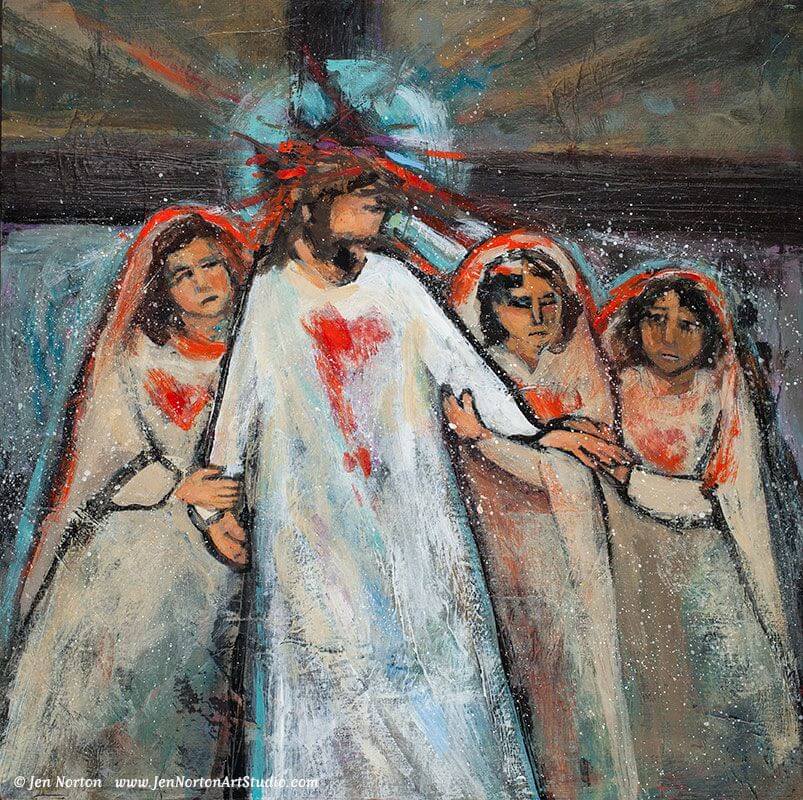
"Jesus Meets the Women of Jerusalem," from Surrender All: An Illuminated Journal Retreat Through the Stations of the Cross, by Jen Norton, Ave Maria Press. Here's a link to view/order her book,SURRENDER ALL
Art...
Jen Norton's website describes her style: "Jen works in acrylic, using expressive color, texture and pattern to reveal the sublime in the ordinary. She begins each painting with underlying layers of intense hues and expressive brushwork, which gradually become hidden from view as the painting progresses. These underlying layers are important to the depth of the final work, just as years of spiritual growth are to a well-rounded soul. Jen seeks to develop order and beauty from underlying chaos."
I believe it is this deep underlying spirituality coupled with commitment to faith-filled everyday life that attracts me to her work and that shines forth in what she creates. "Meaningful relationships and everyday moments of family and home are her subject matter, revealing the Jesuit principles of finding God in the everyday and mundane that were instilled in her education." Amen to that.
To Ponder...
A question of Solidarity
Different Bibles will title this section "Jesus Meets the Women of Jerusalem," or Jesus Comforts the Women of Jerusalem." The term "comforts" is loaded with meaning in that while they were there to comfort Jesus, it is Jesus who comforts them. But Jesus' comfort is fraught with dire warning. There is reciprocity in this. Both Jesus and the women see the pain of the other and respond with heartfelt compassion, even as both know the danger that awaits. The women know Jesus is about to die a horrible death. Jesus knows the children of these women will get caught up in a catastrophic event within their lifetime. Neither Jesus nor the women flinch in the face of their knowing. Instead, they do as they are inwardly compelled and extend such mercy as is theirs to give.
Is that mercy wasted? What difference does it make? Will not Jesus be as dead? Will not Jerusalem be as destroyed? In this moment is a Resurrection preview or insight. For without the promise that is the Resurrection, the answer most without certainly is without hope. How else can we explain the action of Jesus, the action of these women as they lean toward one another in solidarity? Solidarity is willingness to stand in the breach when hope is not apparent, to commit to the long haul.
Pause to consider who you may know in history or in your life who has taken a stance of solidarity and made a difference in life-giving ways.
The Tenderness of Jesus
This scene captures the essence of Jesus' encounters with women in the Gospels. He never failed to notice, to set aside what he was doing in the moment, because he recognized their need. He recognized their worth. It has been my privilege these many years to specialize in these holy interactions. As I wrote in WHY THESE WOMEN:
"Jesus calls out to any who have felt inconsequential, beneath the radar of human recognition, and probably, as unknown to God as God was unknown to them. "Unknown to God," is not an option in the world that Jesus created...He somehow held it all within him, the stories that resided within all those he encountered. He recognized their backstories as soon as he met them. He saw the connections that knit us all together, how each of us carry within us memory of a past beyond our awareness. None of this is wasted in Jesus." (pp. 150,151)
The Gospels also do not flinch in representing the many ways in which women are victimized--if we have eyes to see where Jesus points us. We see in his actions and words that one of his main reasons for coming was to draw attention to the plight of women, children and all those endangered and marginalized. They are, in fact, the reason he has taken up this cross, chosen to do so.
As followers of Jesus it is ours to acknowledge that even after 2000 years of lived experience with the message of Christ, the oppression of women and, by extension, of children, is a systemic sin among us still. Contrary to the Gospel as this is, we are left to wonder if we have missed the message or become used to the suffering.
How have women borne the brunt of much of the world's suffering? How have they been instrumental in change for the good?
The Midrash below was written in the voice of one of the Jerusalem women in response to considering these ponderings...
Midrash...
Tikva called out to me to hurry when she came running to my home. In the company of other women, we have begun the practice of intentionally witnessing executions under Roman rule. To comfort the dying is an act of mercy in Judaism so the Romans, though they scorn us, tolerate our presence. We know the comfort it gives to the condemned to see us and we also know that our presence indicts the injustice being done. So we do what we can.
Today, however, my mother-in-law had left for market and I had no one with whom I could leave my toddler son and I am still nursing my infant daughter. I hesitated but a moment, and then bundled them both into my arms and followed Tikva to the road that led to Calvary.
There the other women told us it was the gentle healer, Jesus, who had been condemned. I prayed they were somehow wrong. They were not. We saw the crowd approach and began, as official mourners, to cry and wail above the noise. Suddenly silence fell over all. Jesus had stopped before us and turned to comfort the ones who'd come to comfort him. "Do not weep for me." The mouth of my infant daughter went slack at my breast as she turned toward Jesus, a smile playing at the corner of her lips. With my one free arm, I grabbed my son's hand as he began to pull away and reach out to Jesus. "Weep for your children." The tenderness of his gaze upon my children melted my mother-heart even as his words struck cold fear.
When I slept I dreamed of daughters, a long line of daughters, granddaughters and great granddaughters. They were many and different--fair faces, dark faces, speaking languages I did not know, but they were all my daughter's daughters. Shoulder to shoulder they stood with babies in their arms and they did not turn their faces away from evil but evil turned from them. For they were strong and they were not alone. Jesus was with them
Mar 29
GOOD FRIDAY STATIONS OF THE CROSS
Join us for WITNESSES ON THE WAY, an in-character, online, interactive Stations of the Cross. We will be adding new witnesses to those used during the Scribbles of Lent to create and pray the 14 Stations together. May we enter into this event with fresh eyes, the eyes and hearts of those who were there.
(We will need a minimum number of 24, so invite others to come with you).
Friday, March 29th
1 pm - 4 pm Eastern Time
Noon - 3 pm Central Time
11 am - 2 pm Mountain Time
10 am - 1 pm Pacific Time
$15.00 - $45.00 Pay-as-you-are-able
Responses from Readers...
I Loved the richness of Moses Hogan's voice. Loved the instrumentation in the other version. It’s all wonderful. Thanks, - Lucille
I appreciated your post on Simon of Cyrene this morning. I thought I'd share with you that I wrote a sermon in 2018, primarily on Simon, and found our research took us down very similar paths. - Blessings to you and yours, my friend, Rev. Chris
Thank you so much for your Lenten Scribbles. I am enjoying each one. I actually like all the different parts supporting the Scripture; the Art, the Background/ history and links that you have shared, the Midrash is very interesting and the Prayer at the end too. I appreciate you and your wonderful gift that you are sharing! - Maria
Your weekly “scribbles” are inspiring me to stick to my daily Lenten reflection and prayer routine. You’re amazing! - Tom
What a beautiful reflection you’ve offered here! You asked what spoke to us most; for me, all of it was painting a more complete picture of an event that so changed our world. The ‘all of it’ would be my answer, so rich, so moving. To imagine being asked to carry the cross when you thought you were there for dinner. I wonder how many times we have encountered that possibility without the sword touching our shoulders and we missed it. - Alic
Contact Kathleen