
Lenten Scribbles from... Sisters In Scripture
Every Wednesday of Lent a new Scribbles will arrive in your inbox with a different character from WITNESSES ON THE WAY, an invitation to enter into the Passion of Christ through the eyes of someone who was there. Each one will feature Scripture, background information, reflection questions, and the words of the character as a Midrash in prayerful response to the story.
On Good Friday, we will add to these seven and host an online, interactive Stations of the Cross--details next week. Please enjoy and ponder these offerings and consider joining us on Good Friday for the gathering of all on the way to the Calvary.
WITNESSES ON THE WAY
Scripture...
Matthew 27:11-26:
Now Jesus stood before the governor; and the governor asked him, “Are you the King of the Jews?” Jesus said, “You say so.” But when he was accused by the chief priests and elders, he did not answer. Then Pilate said to him, “Do you not hear how many accusations they make against you?” But he gave him no answer, not even to a single charge, so that the governor was greatly amazed.
Now at the festival the governor was accustomed to release a prisoner for the crowd, anyone whom they wanted. At that time they had a notorious prisoner, called Jesus Barabbas. So after they had gathered, Pilate said to them, “Whom do you want me to release for you, Jesus Barabbas or Jesus who is called the Messiah?” For he realized that it was out of jealousy that they had handed him over. While he was sitting on the judgment seat, his wife sent word to him, “Have nothing to do with that innocent man, for today I have suffered a great deal because of a dream about him.” Now the chief priests and the elders persuaded the crowds to ask for Barabbas and to have Jesus killed. The governor again said to them, “Which of the two do you want me to release for you?” And they said, “Barabbas.” Pilate said to them, “Then what should I do with Jesus who is called the Messiah?” All of them said, “Let him be crucified!” Then he asked, “Why, what evil has he done?” But they shouted all the more, “Let him be crucified!”
So when Pilate saw that he could do nothing, but rather that a riot was beginning, he took some water and washed his hands before the crowd, saying, “I am innocent of this man’s blood see to it yourselves.” Then the people as a whole answered, “His blood be on us and on our children!” So he released Barabbas for them; and after flogging Jesus, he handed him over to be crucified.
Art...
Over twelve feet high, Ciseri's painting of this scene is imposing and impressive. He uses luminous color and transparent whites, adding details of clothing and architecture that give historical substance. His most effective technique, however, may be perspective. By putting us behind the scene, we are immediately drawn in and invited to consider our place in not only the picture, but the historical event, and in its consequence. Everyone in the scene has their back to us--Jesus' back is stripped bare and bloodied. We see faces only in profile; attitude is conveyed by the posture of each figure: the arrogant, almost bored soldier, Pilate's theatrical gesture, Jesus' erect dignity.
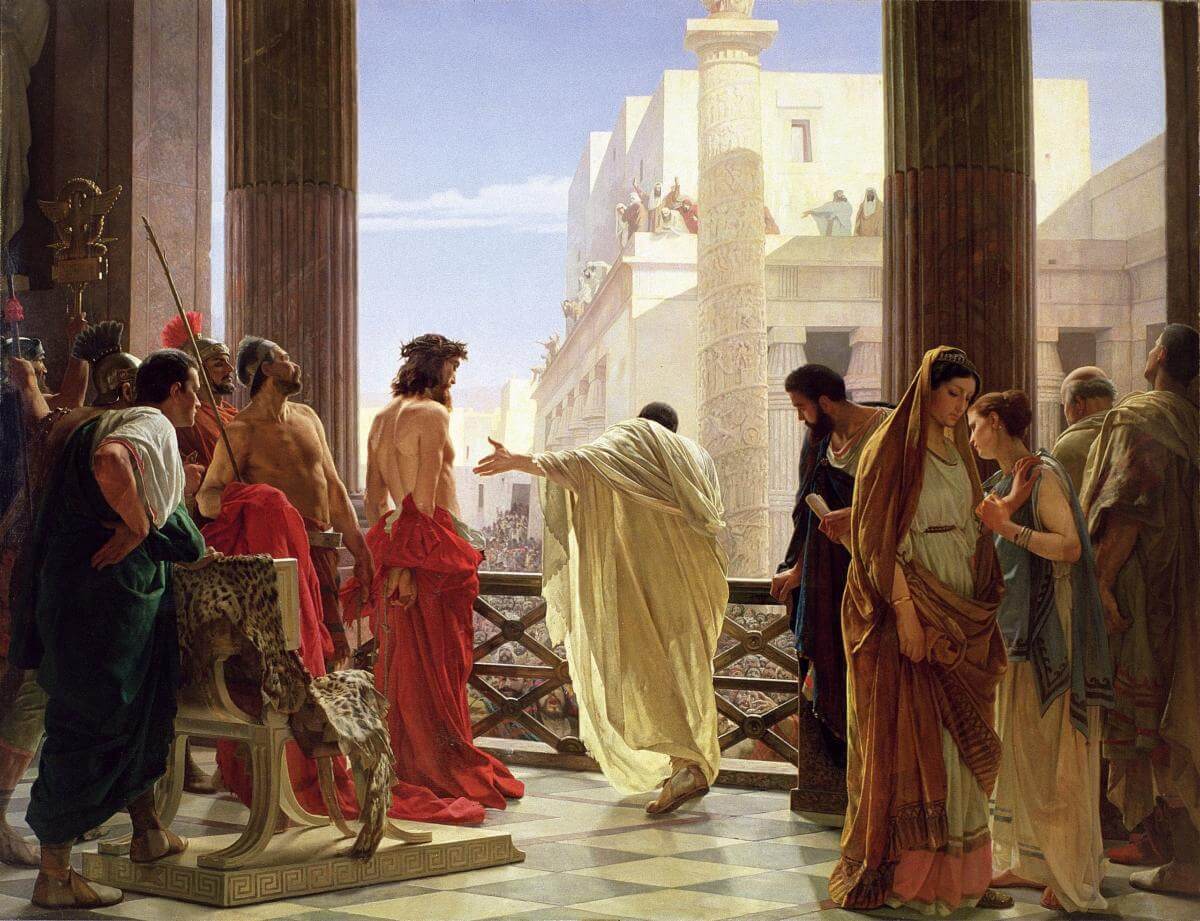
"Ecce Homo," 1870-1890, by Antonio Ciseri, 1821-1891
The sole exception is the wife of Pilate. We see the full expression of anguish on her face as she turns toward us, leaning slightly on the shoulder of her servant for emotional support. Though looking away from the action, she alone seems to realize the consequence of what is going on.
To read more about Ecce Homo, you might enjoy this,3 min art tutorial
Some background...
From History:
History has verified that Pontius Pilate was the prefect of the Roman province of Judea under Emperor Tiberius, 26-37 AD. TIn 1961, archeologists found a stone fragment known as the Pilate Stone on which was the inscription, "building in honor of Tiberius...Pontius Pilate...prefect of Judea." The name Pontius Pilate may indicate that his family came from the clan of Pontii or it may reference "pilatus," the Roman word for javelin/spear, and refer to his military prowess.
Prefect was a military as this was military posting. Judea had only been under direct Roman rule for 20 years and the role of the prefect was to keep law and order and suppress the population as needed to do so.
Luke's gospel makes reference to an event in Pilate's rule, "Now on the same occasion there were some present who reported to Him about the Galileans whose blood Pilate had mixed with their sacrifices."(13:1) Pilate is also mentioned by the Jewish historian, Josephus, in incidents that recount his conflicts with the Jews. He hung standards or worship images in Jerusalem that caused a riot and struck coins with pagan religious symbols that also offended the Jews. After the death of Jesus, he sent the cavalry in response to a gathering of Samaritan Jews heading up Mr. Gerezim that ended in many deaths. The Samaritans reported him to the Legate of Syria, his superior, who ordered him back to Rome to answer for his actions to Emperor Tiberius. Tiberius died, however before Pilate arrived and there are no further records.
Here are excerpts from Josephus if you would care to Read more...
From Tradition:
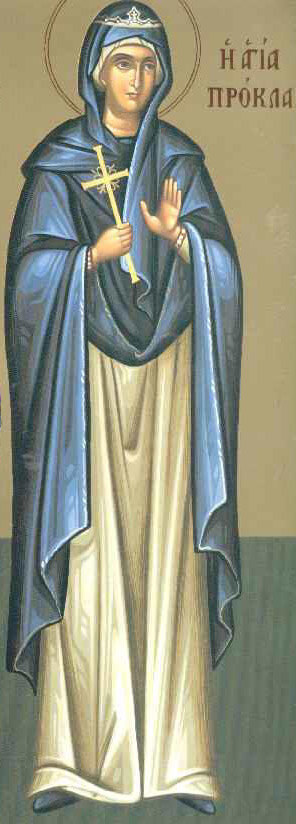
The historical trail for Pilate runs cold once he returns to Rome. Myths however abound—that variously have him die of disgrace in Rome under Caligula, commit suicide out of remorse, or become a Christian and be martyred. He is venerated as a saint in the Egyptian and the Coptic Orthodox Churches, as is his wife, who is given the name St. Claudia Procula.
To Ponder...
The Midrash below was written in the words of Pilate's wife in response to pondering these questions.
Midrash...
Midrash is a Jewish, rabbinical tool used to respond to a question raised by the biblical text. Inspired by that model, we frequently invite folks to ponder and pray and then use their creative imagination to create a kind of backstory or response to the scripture presented. The Midrash below was written in the words of Pilate's wife in response to the questions above.
I was there watching from the adjoining room, my head still throbbing from my troubled dreams. “Have nothing to do with that just man.” That’s what I told my husband. He tried. He told them this man was innocent. He offered them Barrabas instead. But in the end it did no good. “Crucify him!” they cried, all in one voice. And I watched as my husband handed him over. He washed his hands to show that it was not of his doing. He washed his hands because he knew I was watching. What good does that do, my husband? Will Jesus be any less dead for all your washing? Are not my hands as stained as yours?
This dirty place has not been kind to us nor brought us any close to honor in Rome. Now none of that matters for after this day nothing will ever be the same again. “He suffered under Pontius Pilate”—that was the refrain in my dream. That will be my husband’s fame. What cruel fate brought us here at this time and in this place? Does each person face the challenge of the history they find themselves in? If so, I pray for more courage than we had this day. I fear for my husband. I fear for myself. And I fear for a world that would kill such a man.
Prayer...
All: Dear Lord, we find ourselves, like Pilate, caught up in the times in which we live, caught up in circumstances we cannot control or change or even predict. Give us vision beyond the immediate horizon, vision to see with your eyes. Help us to find the courage to listen to the voice of conscience, to your stirrings within us. May we always place our service to You above all else in our lives.
Contact Kathleen
NEXT WEEK - SIMON OF CYRENE
Orthodox icon of St. Claudia Procla