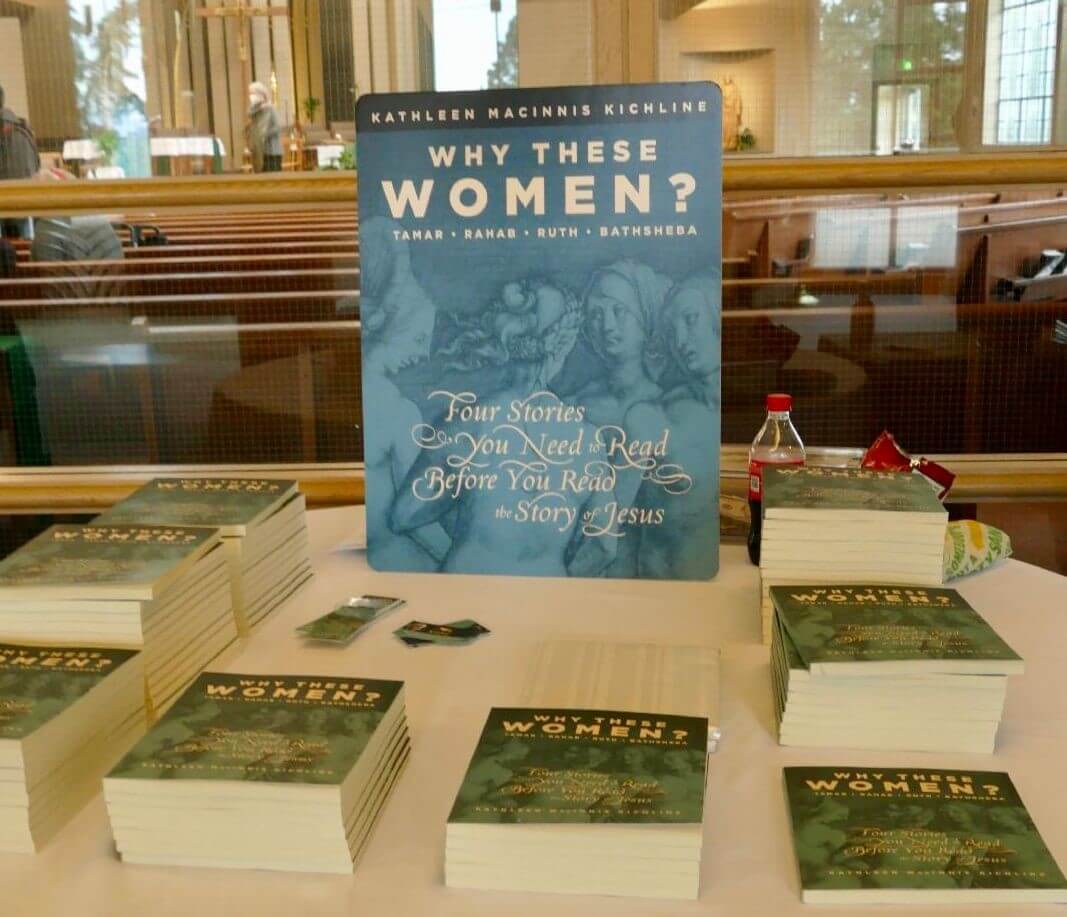
TAKE A TASTE from WHY THESE WOMEN
Each newsletter carries a link to one of these different samples from the book:
•Follow the Power - Feb 9th
•What Does it Take? - Feb 23rd
•Cameo - Mar 9th
•Bible Study Tools - TODAY
•Midrash

In today's sample from WHY THESE WOMEN we use the tools of biblical scholarship to understand the confusing scene in Gen. 38: 1-39 when Tamar seems to seduce her father-in-law. Pour yourself a cup of coffee/tea, get out your Bible, read Gen. 38:1-39, put on your thinking cap and settle in...
"So, what was Tamar doing sitting by the side of the road where she knows her father-in-law would pass on his way to shearing? In the time of the patriarchs, women sitting by the side of the road were fair game sexually, whether they are prostitutes or not. Did she know more than the route Judah would normally take? Did she know, perhaps, that her father-in-law would be apt to avail himself of sexual favors given the chance, either because men tended to do that or because she knew him well enough to know he was likely to do so?
To answer these questions, let us use a kind of biblical scholarship called redactive criticism which takes a close look at the text, the words, and the context. One tool is to look at a specific Hebrew word and compare it to other places in scripture where that same word appears.
“She put off her widow’s garments, put on a veil, wrapped herself up” (vs. 14). A veil is not the normal garb of a prostitute who would, instead, seek to appear alluring. Rather, it hides her face and identity or perhaps it operates on a symbolic level. The only other time in the Old Testament that a veil is mentioned with the same phrasing and choice of words is in when Rebeka alights from her camel to first encounter her groom, Isaac, and she “took her veil and covered herself” (Gen 24:66). In this case, it has bridal overtones, a wife preparing to meet her husband. Is Tamar, here, ritually preparing to meet her “surrogate” husband, as per the Levirate Law? This allusion to Rebeka is significant as it places Tamar in the exalted company of a matriarch.
Tamar sits down at the entrance to “Enaim on the way to Tinmah” (38:14). The narrator here is giving us an interesting play on words. Enaim’s literal meaning is “the opening of the eyes” or more playfully, “on the way to a reckoning.” So, the intent or set up is clear. As Jewish scripture scholar, Tikva Frymer-Kensky, puts it, “Tamar is playing a dangerous game. She must close Judah’s eyes in the present, or else he won’t sleep with her, but she must provide a way to open them in the future, or she will be in serious trouble.”[i]
Though Judah takes the initiative, there seems little doubt that he is acting in accordance with Tamar’s expectations for she has a ready answer to how he can provide payment. In asking for Judah’s signet, cord, and staff, Tamar was essentially asking Judah to hand over his wallet, passport, and car keys. She was bold and Judah was compliant. When Judah’s friend, Hirah, later went in search of “the woman” to make payment, Gen 38:21 uses the word qedesa. Some translations suggest this as “temple prostitute” but a quedesa was not a sacred prostitute. She was a public woman, one that could be found along the roadway where virgins and married women should not be. Such a woman might engage in sex, but she might also be sought out for lactation, midwifery, or other female purposes.
When the “prostitute” cannot be found for payment, Judah would rather leave behind his identifying seal, cord, and staff than call attention to the situation. “We shall become a laughingstock” (vs. 23). It was not illegal for a man to avail himself of a prostitute, but Judah is concerned about what people will think of him. Soon he has larger things to worry about for he gets word that his daughter-in-law is pregnant and has brought shame upon his family, a far more serious allegation that opens him and all his family to ridicule. He is outraged and seeks immediately to bring her to justice, wanting her burned alive for her evil, though the usual punishment is stoning.
At this point, Tamar is most vulnerable, “And Judah said, ‘Bring her out and let her be burned’” (38:24). But her forethought pays off. She produces the evidence and calls out, “Take note, please!” (NRSV), “See!” (NIV), “Please examine!” (NASB) (38:25). Judah has been too blind to see God’s justice in the death of his sons, too blind to notice the plight of Tamar and the right he has denied her, too blind to recognize the veiled woman as his daughter-in-law. Now he sees. He recognizes the staff and seal and understands for the first time, all that he has failed to understand, declaring, “She is more in the right than I am, since I did not give her to my son Shelah” (38:26).
God also recognized the righteousness of Tamar. She became the mother of twins as did Rebekah and there is, once again the Tamar-Rebekah connection. The words used to describe the Tamar’s delivery are an exact duplicate of the words used to describe Rebekah’s: “When the time came for her to give birth, there were twins in her womb.” (Gen 25:24 and Gen 38:27). Thus, the importance of this event is underscored, and Tamar is securely placed in the company of the Matriarchs, presented, even, as a second Rebekah.
[i] Frymer-Kensky, Tikva, Reading the Women of the Bible: A New Interpretation of Their Stories, (New York, Schocken Books, 2002), p. 271.
And the reason for Lent is ... EASTER
ENCOUNTERS WITH THE RISEN LORD
April 5 - April 10, 2022
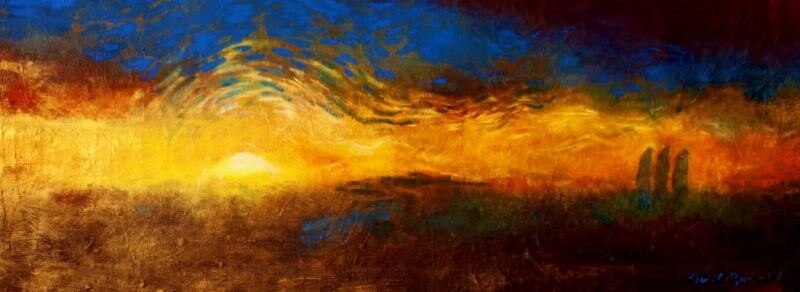
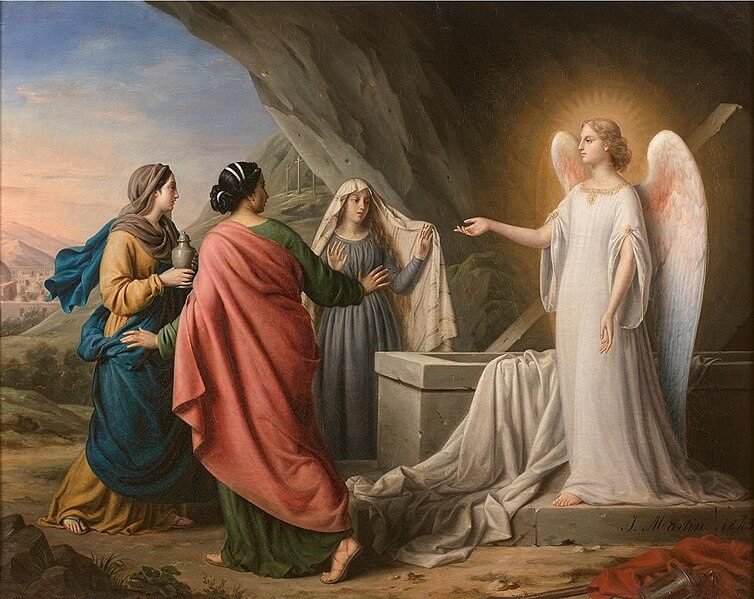
The three women on the tomb of Christ, painting by Irma Martin, exhibit at the Salon of 1843
Easter Monday
The Women at the Tomb
Easter Tuesday
Mary Magdalene in the Garden
Easter Wednesday
The Road to Emmaus
Easter Thursday
The Upper Room/ Doubting Thomas
Easter Friday
By Shores of the Sea of Galilee
Easter Saturday
The Ascension ( a look ahead)
St. Placid's Priory cordially invites you to linger in the presence of the Risen Lord, each morning of the week after Easter, Monday, April 5 - Saturday, April 10, 2022 from 9:00-10:30 (PDT).
Begin every day focused on a different Resurrection appearance via Zoom. Kathleen will use the scripture story along with artwork, song, and reflection to help you extend the joy of Easter
$150 / 6 Sessions, full week
Many thanks to Pastor Karen Fowler-Lindemuller and the parishioners at United Lutheran of Bella Vista for graciously opening their parish home to me and WHY THESE WOMEN.
As a newcomer to Northwest Arkansas, I particularly appreciate the opportunity to make some local connections. Thank you also to Jeremy Fowler-Lindemuller who video-taped the session, WTW at United Lutheran, and to Betty Wehner for serving up coffee, chocolate chip cookies and lemon bars 🙂