

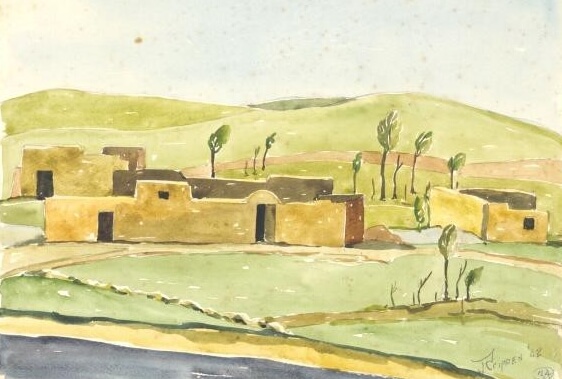
The Healing of Naaman, 2 Kings: 1-15
We are told that Naaman’s household included "a little girl from the land of Israel.” She had been taken captive and waited upon Naaman’s wife. Unnamed and enslaved, she speaks out of her anonymity and bondage, a word of hope. Far from her home and upbringing, she still remembers Elisha, the prophet of Israel, she remembers YHWH, the God of Israel, and is confident of God’s ability and willingness to heal her master. She is the one who initiates the action; her words begin Naaman’s journey of healing. Because of her, Naaman goes to the king of Aram asking him to make a request of the king of Israel. As the story shifts from the powerless to the powerful, the little girl recedes again into the background.
Disney, no doubt, would have this story end differently. We may surmise and hope from the story that this child had a positive relationship with Naaman and his wife, but, like Disney, we don’t like the very real circumstances of her life. Neither did Jesus’ listeners. Their history and enmity with Naaman’s people was far too painful and deep for that. Likely, Naaman, as a captain of the army, led raids against Israel, raids that resulted in the capture of women and children--possibly, how he acquired the little girl. I Kings 20: 3,6 describes these raids as when the king of Aram issued an ultimatum to the king of Israel, "Your silver and gold are mine; your fairest wives and children also are mine…I will send my servants to you tomorrow about this time, and they shall search your house and the houses of your servants and lay hands on whatever pleases them, and take it away."
This time in their history, when their ancestors failed to protect even their wives and children, is not one of which Jesus' neighbors would want to be reminded.
Elijah and the Widow of Zarephath, 1 Kings 17
Both of these stories take place in a dark time of Israel's history, a time that led to the fall of the Northern Kingdom. Elijah's story is the earlier of the two, in a time when Ahab was king of Israel who "did evil in the sight of the Lord, more than all who were before him." Ahab's notorious wife, Jezebel, had introduced the worship of the Canaanite god, Baal. The Baal cult believed that the storm god was responsible for bringing life giving rains at the right time of year, restoring fertility to the land. Elijah confronted Ahab with God's edict that there shall be no dew or rain for three years except by his word. Essentially, Elijah was saying, you have this all wrong. No false Canaanite god can open the heavens and bring rain, only YHWH. And to prove it, there will be no rain for three years.
In going to Zarephath, Elijah went to the heartland of the Baal cult. His sojourn with the widow there falls rather neatly into two halves, vs. 8-16, and vs. 17-24. First he imposes himself upon her hospitality at a time of dire need--at the point of dying. Then after she, her son, and he are miraculously provided for, the unthinkable happens and her son dies, bringing about the even greater miracle of YHWH restoring him to life through Elijah.
As with the little girl in Naaman's story, let us focus on the widow in this story. We can safely assume that God would surely have provided for Elijah during this time of drought and famine, even as had been done with the ravens in the Wadi. But what of the widow? She and her son would have likely been among the first to die. I found an intriguing Midrash about God’s motives in the Jewish Women’s Archives. This Midrash states, "Elijah’s stay in the house of the widow was meant to bring him closer to the suffering prevalent in the world, and to acquaint him with the hunger and want from which the women and children suffered.” https://jwa.org/encyclopedia/article/widow-of-zarephath-bible
If we re-frame this story to be about the widow and Elijah's becoming aware of her plight, our understanding shifts, as with the little girl, to what is happening in the margins of the story. The widow, her son, and the little girl speak to our own presumption, how willing we are to overlook others as we follow the story line of our own lives. Our lives, it turns out, are inextricably linked to others and their well being. We have no more claim to the fast track than did the people of Nazareth who'd hoped to share in the glory of the local-boy-made-good but who, instead, told them stories they did not want to hear.

Here's a quick brain-stormed list of things we can do. Send me your ideas in return. contact me
As a small child I learned that if I chose to forego some small pleasure or take on some unpleasant task, this could bring blessing to another. Later I came to see this as the economy of God's grace. Our actions, united to Christ, are never wasted. Like a spiritual ecology, we are all interdependent. Even when I could not be physically present to do the good I would want for another, God's ever-present grace meant I could make a difference. Today that may translate into connecting such things as the annoyance of waiting in line being offered up for my nephew's anxiety over medical test results. The aches and pains of an especially hard-working day can not only remind me of those unable to work, they can be offered as gift to God for these others.
In today's crisis, our not being able to come together, our temporary experience of social isolation, can, by God's grace, bring solace and peace to those who live alone as we send our intention their way. Our willing "offer up" of aches and pains and illness can bring relief to others suffering from this epidemic. Our fasting from community will surely make us appreciate community all the more but can it also inspire us to become creative about ways to build bridges of connection? When our newly attuned awareness, like that of Elijah, further prompts us to action all the better.
2 Kings 15: 1-15
Now Naaman, captain of the army of the king of Aram, was a great manwith his master, and highly respected, because by him the LORD had given victory to Aram. The man was also a valiant warrior, but he was a leper. 2 Now the Arameans had gone out in bands and had taken captive a little girl from the land of Israel; and she [b]waited on Naaman’s wife. 3 She said to her mistress, "I wish that my master were [c]with the prophet who is in Samaria! Then he would cure him of his leprosy.” 4 [d]Naaman went in and told his master, saying, "Thus and thus spoke the girl who is from the land of Israel.” 5 Then the king of Aram said, "Go [e]now, and I will send a letter to the king of Israel.” He departed and took with him ten talents of silver and six thousand shekels of gold and ten changes of clothes.
6 He brought the letter to the king of Israel, saying, "And now as this letter comes to you, behold, I have sent Naaman my servant to you, that you may cure him of his leprosy.” 7 When the king of Israel read the letter, he tore his clothes and said, "Am I God, to kill and to make alive, that this man is sending word to me to cure a man of his leprosy? But consider now, and see how he is seeking [f]a quarrel against me.”
8 It happened when Elisha the man of God heard that the king of Israel had torn his clothes, that he sent word to the king, saying, "Why have you torn your clothes? Now let him come to me, and he shall know that there is a prophet in Israel.” 9 So Naaman came with his horses and his chariots and stood at the doorway of the house of Elisha. 10 Elisha sent a messenger to him, saying, "Go and wash in the Jordan seven times, and your flesh will be restored to you and you will be clean.” 11 But Naaman was furious and went away and said, "Behold, I [g]thought, ‘He will surely come out to me and stand and call on the name of the LORD his God, and wave his hand over the place and cure the leper.’ 12 Are not [h]Abanah and Pharpar, the rivers of Damascus, better than all the waters of Israel? Could I not wash in them and be clean?” So he turned and went away in a rage. 13 Then his servants came near and spoke to him and said, "My father, had the prophet told you to do some great thing, would you not have done it? How much more then, when he says to you, ‘Wash, and be clean’?” 14 So he went down and dipped himself seven times in the Jordan, according to the word of the man of God; and his flesh was restored like the flesh of a little child and he was clean. 15 When he returned to the man of God [i]with all his company, and came and stood before him, he said, "Behold now, I know that there is no God in all the earth, but in Israel; so please take a [j]present from your servant now.”
1 Kings 17
Then the word of the LORD came to him, saying, 9 "Arise, go to Zarephath, which belongs to Sidon, and stay there; behold, I have commanded a widow there to provide for you.” 10 So he arose and went to Zarephath, and when he came to the gate of the city, behold, a widow was there gathering sticks; and he called to her and said, "Please get me a little water in a [d]jar, that I may drink.” 11 As she was going to get it, he called to her and said, "Please bring me a piece of bread in your hand.” 12 But she said, "As the LORD your God lives, I have no [e]bread, only a handful of flour in the [f]bowl and a little oil in the jar; and behold, I am gathering [g]a few sticks that I may go in and prepare for me and my son, that we may eat it and die.” 13 Then Elijah said to her, "Do not fear; go, do as you have said, but make me a little bread cake from [h]it first and bring it out to me, and afterward you may make one for yourself and for your son. 14 For thus says the LORD God of Israel, ‘The [i]bowl of flour shall not be exhausted, nor shall the jar of oil [j]be empty, until the day that the LORD sends rain on the face of the earth.’” 15 So she went and did according to the word of Elijah, and she and he and her household ate for many days. 16 The [k]bowl of flour was not exhausted nor did the jar of oil [l]become empty, according to the word of the LORD which He spoke through Elijah. 17 Now it came about after these things that the son of the woman, the mistress of the house, became sick; and his sickness was so severe that there was no breath left in him. 18 So she said to Elijah, "What do I have to do with you, O man of God? [m]You have come to me to bring my iniquity to remembrance and to put my son to death!” 19 He said to her, "Give me your son.” Then he took him from her bosom and carried him up to the upper room where he was living, and laid him on his own bed. 20 He called to the LORD and said, "O LORD my God, have You also brought calamity to the widow with whom I am [n]staying, by causing her son to die?” 21 Then he stretched himself upon the child three times, and called to the LORD and said, "O LORD my God, I pray You, let this child’s life return [o]to him.” 22 The LORD heard the voice of Elijah, and the life of the child returned [p]to him and he revived. 23 Elijah took the child and brought him down from the upper room into the house and gave him to his mother; and Elijah said, "See, your son is alive.” 24 Then the woman said to Elijah, "Now I know that you are a man of God and that the word of the LORD in your mouth is truth.”