
Listen to today's SCRIBBLES here
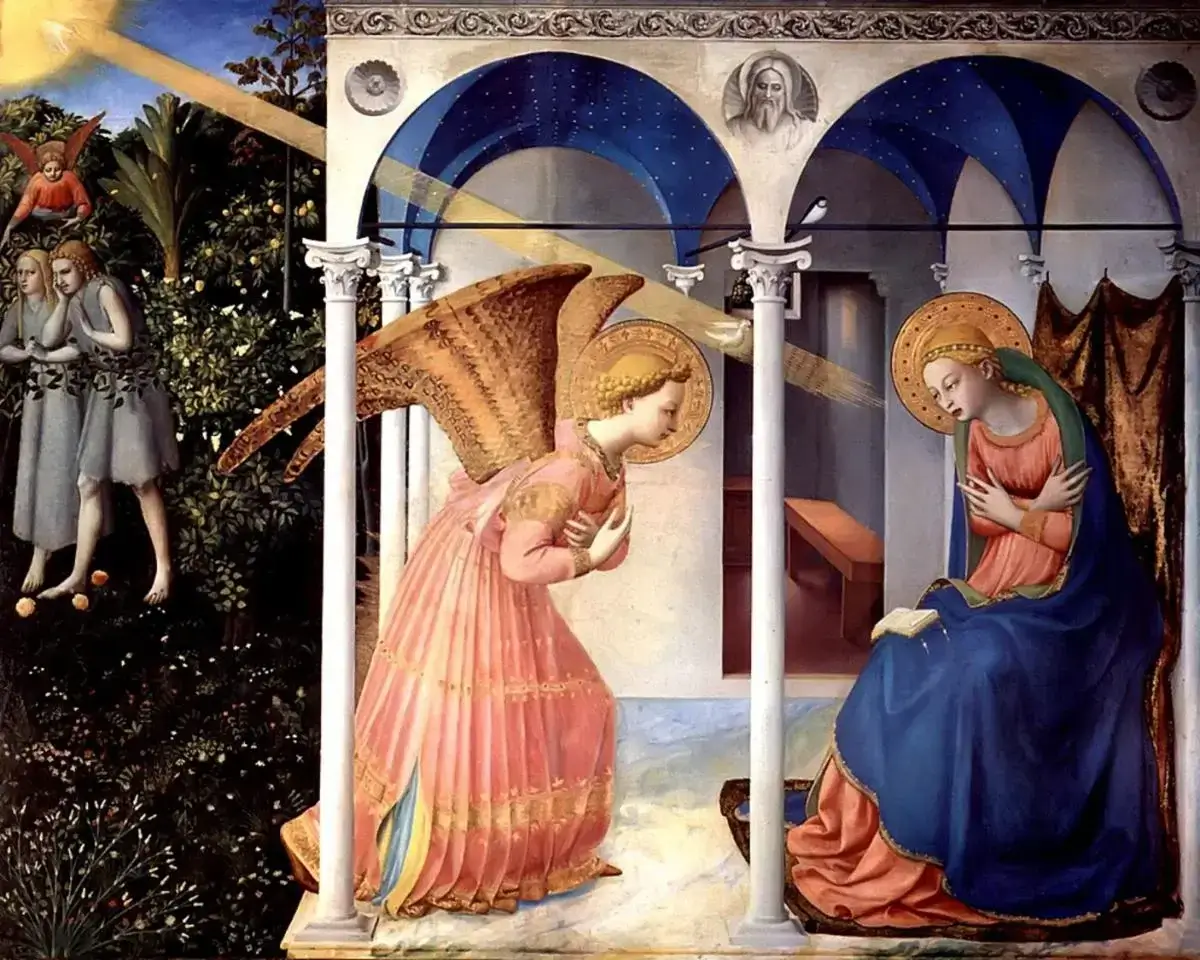
(The Annunciatory Angel, Accompanied by Angels: Poems of Incarnation, Luci Shaw)
Scribbles from...
What was Mary doing when the angel Gabriel appeared? This is the question I have used to open many an Advent Retreat. Over the years, I have received a wide array of answers. Praying, reading, sewing--as we often see portrayed, but also baking bread, walking to her grandmother's, doing the laundry... My good friend and retreat partner, Betsey Beckman of The Dancing Word, chose that last scenario when she choreographed the StoryDance of the Annunciation. She drew colorful, flowing scarves from a laundry basket as she gave movement and music to the telling of the story.
The Annunciation is one of the most frequently painted of biblical scenes. Betsey's setting of choice invited us to took at the way other artists had chosen to depict the scene. In today's SCRIBBLES we look at just one of those pictures. I believe each one has the much to reveal but I have chosen Fra Angelico's Annunciation from San Marto, in part, because I love Fra Angelico, but also because the poet, Luci Shaw, offers some insightful words as she considers the scene from the vantage point of the Angel.
"How does an angel look? We are not Daniel or Zechariah; we have not been shown. This rendering suggests not celestial power and radiance but a weight of apprehension; what must be announced will not be entirely easy news.
"How does an angel look? We are not Daniel or Zechariah; we have not been shown. This rendering suggests not celestial power and radiance but a weight of apprehension; what must be announced will not be entirely easy news.
"How might it feel (if an archangel has feelings) to bear this news? Perhaps as confounded as the girl? We worry that she might faint. Weep. Turn away, perplexed and fearful ..She is so small and intact. The turmoil might wrench her.
"She might say no."
She might say no. Rarely, if ever, do we consider this possibility. And yet, it must be so. For, without the possibility, the freedom of “no,” a true “yes,” cannot exist. And this yes was, and needed to be, as free a yes as ever a yes could be.
There are two things about this for us to consider.
First, this tells us a good deal about Mary. Just as artists strive to portray the divine being made real in the world, Mary’s “yes” exists at the intersection of heaven and earth. It is not just a moment in time; it transcends time and is a gift into the future empowering those in generations to come, just as Mary herself says a few lines later in her Magnificat. Hers is the first of many “yes’s that bring about Incarnation.
For, the one thing she did is the one thing we all have to do, to bear Christ into the world.
“May Christ be born in you.” On my Advent retreats, we dare to use this as our greeting to one another, for that is, indeed, our task.
If Christmas tells us anything, it tells us that God has every intention of showing up in our lives. Christmas is not relegated to the distant past, something to simply remember; it is a present reality. And the beginning of that reality is our “yes,” like Mary’s, a yes to God’s fully entering our lives. In so doing, we say yes to becoming Christ-bearers to a world so much in need of Christ today.
Like Mary, we are not asked to perform heroics, hasten off to a nunnery, nor do we get to enjoy privilege. She continued to live the simple life of a carpenter’s wife in a small backwater village during a dark and dangerous time. But she lived that life with the deep faith, the certitude of God-with-us, Emmanuel. This is our great hope as well, and the one cure for fear—trust in God
Secondly, this is also incredible insight into the nature of God.
As another poet, Denise Levertov paints the scene:
"She was free
to accept or to refuse, choice
being integral to humanness."
“Choice being integral to humanness.” The word, “human,” come, after all, from hummus, or earth, dirt. In Genesis 2, God forms humankind out of the clay of the earth and breathes life into that clay. Could not God have chosen, to become human, “of the earth,” a new Adam, by once again taking earth and breathing life into it? God could have acted unilaterally, God being God. If the story of Jesus had begun with his simple appearance on the scene without any backstory, any narrative of his beginnings, we would be none the wiser.
Yet Godchose to do otherwise. God chose to wait upon the yes of another. God chose to so fully enter human existence as to experience birth, dependency, growth, and learning, the interaction and cooperation of others.
How remarkable that God, who has no beginning, chose to be subject to the free choice of others, in this case, Mary. This honors the foundational human condition that--get this, folks--we do not get to act unilaterally. In God’s becoming human, one of us, God accepts this same condition.
And, yes, we are subject to the choices made by others. We benefit from the choices made by others. Almost every civic holiday recalls and celebrates that we enjoy our freedom because of the sacrifices of others. We would not even alive except by the choices of others—to conceive, bear, educate and raise us, but also to plant crops, build roads, practice medicine, and pay taxes.
We also suffer from the choices made by others. On a global scale, we are born into a certain time and place, just like Jesus was, and we inherit all that means. The world has made selfish and calamitous choices throughout history up to and including our own time. We can turn on the TV at any time and find our world is suddenly and irrevocably changed. On a smaller, more personal, and deeply felt scale, we also suffer because of the poor choices of others, especially of loved ones. And our loved ones suffer because of our poor choices. And yet, God chose that condition, chose to make holy this burden we bear. All of this because God waited upon the yes of a young Jewish maiden.
I have come to believe after many years of pondering it, that the reason for Advent is not simply that we prepare for Christmas. It is not even that we await Christ’s coming. The reason for Advent is that Christ waits for us. Like Gabriel before Mary, Christ waits upon our awaiting. In that mystery of God’s great longing for us, Christ does not, cannot come without the beckoning of our need and great desire.
Unless our hearts become the empty manger, where shall Christ be received?
May Christ be born in you!
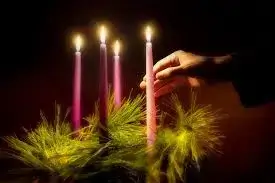
This is my Advent greeting, hope, and blessing to all of you. May your days be marked by growing Hope, Peace, Joy and Love as symbolized by the Advent wreath.
Responses from our Readers...
Contact Kathleen
I love to hear from you, friends! Please drop me a line at Contact Kathleen
If you are new to Sisters in Scripture, I would love for us to stay in touch. To receive regular emails, sign up here.