Please ensure Javascript is enabled for purposes of website accessibility

An Advent Gift Week Four

Be sure to check the exciting news at the end -- the God Hears Her Podcast is LIVE!

Scribbles from...

"For, the purpose of Advent is not that we await the coming of Christ; it is that Christ waits upon our awaiting. On some level, Christ does not, cannot come without the beckoning of our need and deep desire. Lest our hearts become the manger, where shall He be received?"(WTW, p. 10).

Another invitation these last days of Advent, to enter into the story in a variety of ways. Enjoy!
MARY AND THE WOMEN OF MATTHEW ONE

Scripture

MARY AND 
THE WOMEN OF MATTHEW ONE

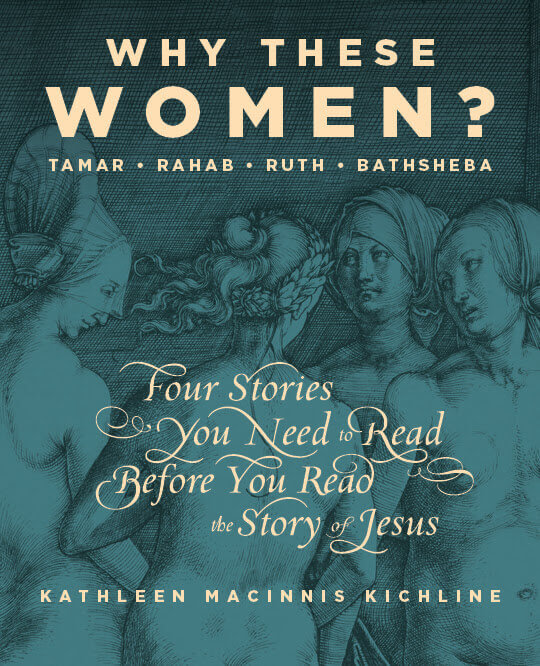
Tamar, Rahab, Ruth, and Bathsheba. They seem at first, odd company for her to keep.  Yet, she belongs with them; each of their lives, in some way, points to hers. As a Jew, she would have learned these stories, studied them, heard them read and discussed at synagogue. How did the stories of these women speak to her? What did she notice as she pondered their lives? Perhaps, she saw the connection in their stories and hers long before any of us did.

ADVENT WEEK FOUR - BATHSHEBA

One day there was a knock on the door. Mary opened it to discover an angel had come to call. Bathsheba opened it to find the palace guard who seized her and carried her away. The stories of these two women start there. Before any of that happens, they are simply women living the life that is theirs. They had a past; they got up that morning with an expected future. But history intervened. With this, most of us can identify. Though our history may be writ small and personal, though it may not affect others far beyond ourselves, we can recall times when the phone rang, there was an encounter, something intervened, and life,—for ilk or ill, was no longer the same as it had been.

Both Bathsheba and Mary would suffer the tragedy of their son’s death, as an infant for one, as a man for the other. If ever you have gazed deep into the face of Mary in Michelangelo’s Pieta, you have seen that grief. The face would be the same whether it beheld the half-clothed figure of a full-sized man, or the delicate features of a new-born babe. Both sons would be as cold as marble.  Both mothers would bear a loss that was theirs alone. There would have been no unkind mention of Bathsheba at Mary’s table. Bathsheba would have been named and remembered along with the rest of the matriarchs. And Jesus, the son of Mary, would have known his ancestor, Solomon, not only as son of David, but also as Solomon, son of Bathsheba. (WHY THESE WOMEN, p. 134)

Writing the above utterly convinced me that Mary and her son would have honored the name of Bathsheba in their home--even though this would have been an exception to the norm within Judaism.

Unique to Bathsheba* of all four women in Matthew One, is the obliteration of her name. Tamar, Rahab, and Ruth are all remembered and revered in Israel, sharing the company of the matriarchs: Sarah, Rebekah, Rachel, and Leah. (WHY THESE WOMEN, p. 116).

* (Of the four times the name of Bathsheba appears in 2 Samuel, two of those are in the title, not the text, where she is three times referred to, but only as "wife of Uriah." Her name appears eight times in the story's retelling in 1 Kings. The only other citation is in the superscript of Psalm 51. The only New Testament reference to her is as "wife of Uriah," in Matthew One. Her name does not appear anywhere else).

Art

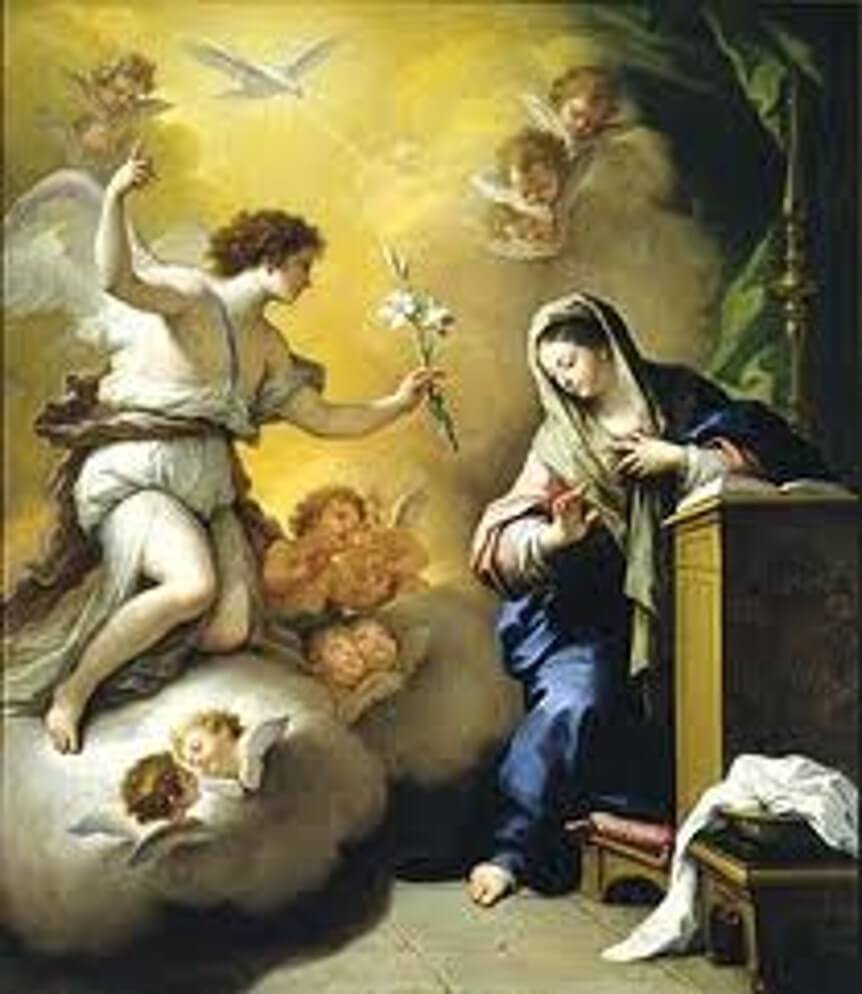
Speaking of beauty, my choice of this Annunciation painting is based largely on the fact that I find it beautiful. We see here many of the familiar elements for an Annunciation portrayal: the open book, the lily, the virginal blue. In this case, the lily is offered by an angel that barely hints at the heavenly, wings neatly folded, halo a thin line of light. The scene is out of doors, a relative rarity, eluding perhaps, to the garden where it all began. The dropped spindle gives a clue to Mary's occupation before the interruption, an intriguing possibility. The gaze between the two--angel and Mary--and the look that passes between them has no need for words, nor goes it give doubt that the message has been spoken.
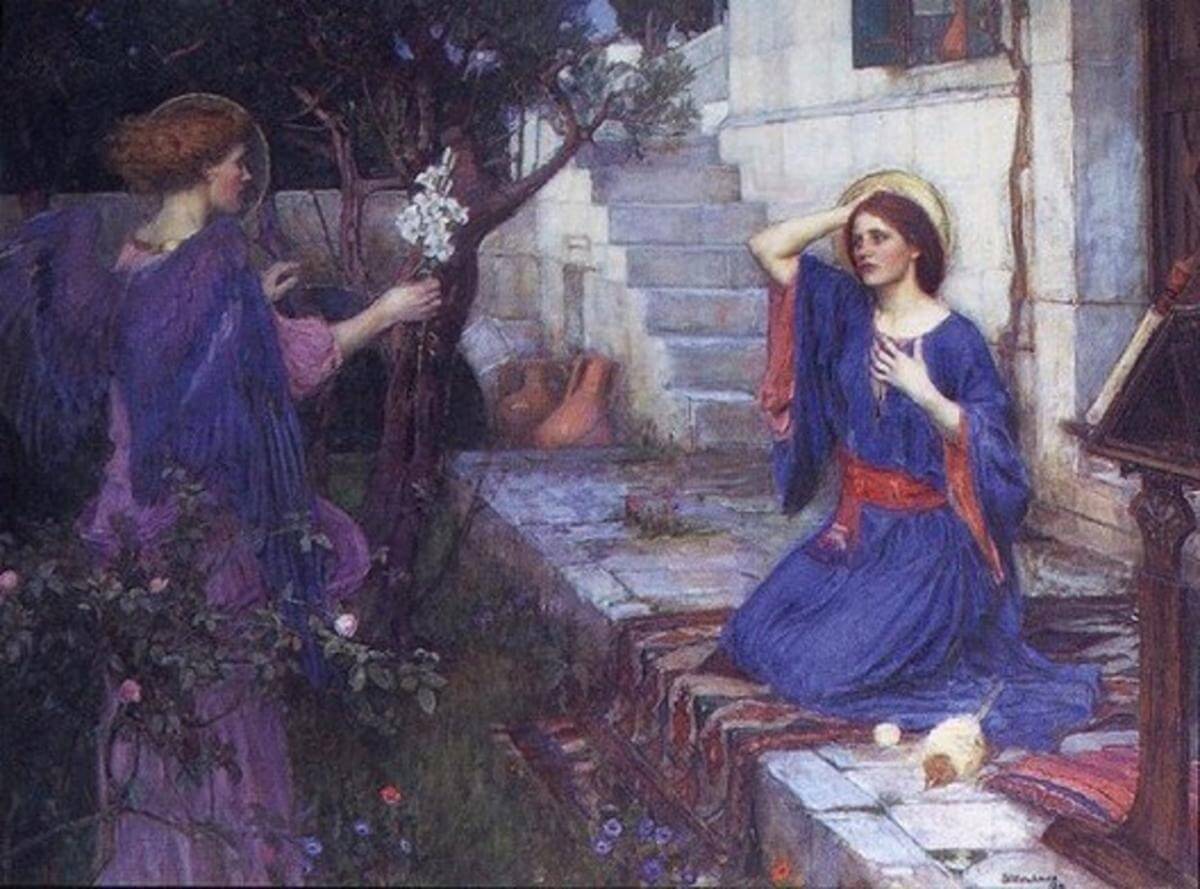
An English painter, John William Waterhouse (1849-1917) created this depiction of the Annunciation in 1914. A romantic, pre-Raphaelite, his works were largely non-religious drawing from mythology, classics, medieval legend, and poetry and most often, featuring beautiful heroines or femme fatales. Mary in such company seems an appropriate choice for a week introduced by Bathsheba.

The wash of blue in this is much of the appeal this holds for me.

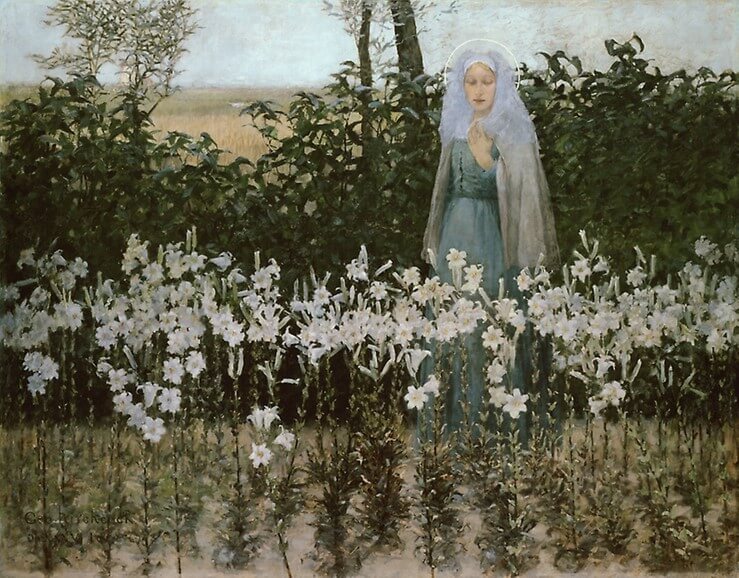
Here is another surprising rendering that reduces the familiar elements of the Annunciation to just two, Mary's blue and the lily, but then goes big with both. It, too, is beautiful and evocative, if only hinting at Annunciation. Were it not for the title, the subject might not be obvious.

The artist, George Hitchcock (1850-1913), was a contemporary of Waterhouse with a similar style. Born American, he studied in Paris and then painted most his life in Holland, where flowers, especially fields of tulips, appear frequently in his work.


Poetry

Annunciation, by Denise Levertov

We know the scene: the room, variously furnished,
almost always a lectern, a book; always
the tall lily.

      Arrived on solemn grandeur of great wings,
the angelic ambassador, standing or hovering,
whom she acknowledges, a guest.

But we are told of meek obedience. No one mentions
courage.

       The engendering Spirit
did not enter her without consent.
        God waited.

She was free
to accept or to refuse, choice
integral to humanness.


Aren’t there annunciations
of one sort or another
in most lives?

        Some unwillingly
undertake great destinies,
enact them in sullen pride,
uncomprehending.
More often
those moments
     when roads of light and storm
     open from darkness in a man or woman,
are turned away from
in dread, in a wave of weakness, in despair
and with relief.
Ordinary lives continue.
                              God does not smite them.
But the gates close, the pathway vanishes.


She had been a child who played, ate, slept
like any other child–but unlike others,
wept only for pity, laughed
in joy not triumph.
Compassion and intelligence
fused in her, indivisible.

Called to a destiny more momentous
than any in all of Time,
she did not quail,
only asked
a simple, ‘How can this be?’
and gravely, courteously,
took to heart the angel’s reply,
the astounding ministry she was offered:

to bear in her womb
Infinite weight and lightness; to carry
in hidden, finite inwardness,
nine months of Eternity; to contain
in slender vase of being,
the sum of power–
in narrow flesh,
the sum of light.
                  Then bring to birth,
push out into air, a Man-child
needing, like any other,
milk and love–

but who was God.

This was the moment no one speaks of,
when she could still refuse.
A breath unbreathed,
                              Spirit,
                                        suspended,
                                                          waiting.


She did not cry, ‘I cannot. I am not worthy,’
Nor, ‘I have not the strength.’
She did not submit with gritted teeth,
                                                     raging, coerced.
Bravest of all humans,
                                consent illumined her.
The room filled with its light,
the lily glowed in it,
                             and the iridescent wings.
Consent,
             courage unparalleled,
                          opened her utterly.

Denise Levertov lived her later years in Seattle where she converted to Catholicism at St. Joseph Parish on Capitol Hill, just blocks from my Alma Mater of Seattle University. I find her poetry lovely and her theological reflections profound. In reading her poetry, I gain appreciation for the holiness of the familiar, for her sights, and sounds, and rhythm of days were the same as my own.

Music

From the beginning, these Advent Scribbles have been based upon the belief that God awaits our waiting, that our longing is somehow a necessary component. The invitation that came to Mary is ours as well. The God of the Universe who spun the moon and stars into being, for reasons of God's own, has chosen for Incarnation to be an act of mutuality. We are agents of Christ's Incarnation, a coming which is, of itself, redemptive. How utterly amazing is that? I find Dan Schutte's song Beyond the Moon and Stars captures beautifully this tremendous human longing. "So great our hunger, Lord, to see your light." Enjoy...

Advent Song

From the beginning, these Advent Scribbles have been based upon the belief that God awaits our waiting, that our longing is somehow a necessary component. The invitation that came to Mary is ours as well. The God of the Universe who spun the moon and stars into being, for reasons of God's own, has chosen for Incarnation to be an act of mutuality. We are agents of Christ's Incarnation, a coming which is, of itself, redemptive. How utterly amazing is that? I find Dan Schutte's song Beyond the Moon and Stars captures beautifully this tremendous human longing. "So great our hunger, Lord, to see your light." Enjoy...

Advent News


THE GENEALOGY OF CHRISTMAS, The podcast interview with Elisa Morgan and Eryn Adkins was aired and went live Monday, December 18th. I finally got to hear it myself and it turned out GREAT! If you have not yet caught it, you can listen here by clicking below (only 26 minutes).

Elisa Morgan and Eryn Adkins, the hosts of GOD HEARS HER, were generous listeners, gracious in their invitation, and enthusiastic in their response. What a marvelous experience of working with other faithful women to bring about God's saving action in the world. I cannot thank you enough, dear friends.

Responses from Readers...

  • Kathleen, thank you for your thoughtful reflections. I especially enjoyed the Bardi painting of the infants in utero, and your analysis of it. It made me remember one of my favorite Christmas carols sung by Roger Whittaker: Momma Mary. It is a joyful, beautiful song about "Mary's little boy, soon to be our savior," and how Mary must have been feeling about carrying God's son. I always look forward to your thought-provoking words, Kathleen!  - Rita
  • Oh Kathleen, what a gift you have given all of us . have forwarded to 13 women who have been a blessing to me. - Katie
  • It's ALL wonder FULL. The music, the art, the poetry, the sculpture, your thoughts and reflections. Thank you. Have a blessed Christmas! - Lucille
  • I never thought before about all the connections between Ruth and Mary. We hear about how the OT prophets foretold the Messiah, but in the pages of Scripture, in the lives of women before Jesus, we also see signs that God was preparing the way all along. - Mary Margaret

I have loved sharing with you the Advent treasures I've collected from years of Advent retreats. I pray it has blessed and enriched your Advent this year, that it has helped you make of your heart a manger to welcome Christ into this world and given you quiet reflection, ideas to ponder, and a rising joy within your heart.

If Mary tells us anything, it is that our yes is essential to God's purpose coming to birth in our lives and in the world. The world of today needs a Savior as earnestly as did the world of 2000 years ago. Let us, like Mary, be quietly (or not so quietly) complicit in bringing that about. I'd love to hear more about how these Advent Samplers have been a part of your Christmas preparation. Please send me your thoughts at Kathleen

If you are new to Sisters in Scripture, I would love for us to stay in touch. To receive regular emails, sign up here.