
To listen to audio version of today's Scribbles, please click here: Please forgive me
Scribbles from...

We turned and trolled slowly down yet another aisle, just one car of many, watching for a shopper to pull out and leave a vacancy. Directly ahead and to the right, the taillights of a Toyota lit up as it began to back out. Before we could pull forward, an SUV coming from the opposite direction turned sharply to the left and executed a quick U-turn in front of us, sliding into the recently vacated space. My husband quickly braked and then advanced toward another space that opened up just ahead. As we passed the SUV, I noted its license plate holder: Alumni Gonzaga University.
“Hmm, a Catholic education run amuck,” I thought to myself. Yes, a bit of judgement there on my part. Mea culpa.
Minutes later, as we were about to enter the grocer’s, a man overtook us, held up his hand and said, “Excuse me, I want to apologize. I was out of line cutting you off back there. I was distracted by my phone, but that’s no excuse. I’m sorry.”
Then he paused and looked at each of us in turn and said, “Please forgive me.”
“Of course,” I replied.
“Please forgive me.” This was language I would have expected from Gonzaga or from any other Catholic University or school. It is part of the liturgy, the Examen, the Sacrament of Reconciliation. It Is more: it is part of the lexicon of thought and being.
We have a moral responsibility to examine our actions in light of justice to others, and to pray for a well-formed conscience with which to do so. “I apologize,” “I was wrong,” “I regret,” even “I am sorry," are minor keys to the language of reconciliation. Of these, “I am sorry,” is the strongest statemen-unless one adds a qualifier like, “that you feel that way.” In that case, the responsibility gets tossed back onto the other party.
“Please forgive me,” takes it up a notch and implies so much more. It acknowledges that we are in relationship with one another and that the relationship has been broken or damaged by something that I have done. To restore right order, the offender asks the one offended for forgiveness. They are given the opportunity to extend forgiveness and make a moral choice in favor of right relationship. It is a mutual exchange.
This social contract of right relationship may be as simple as the role of being fellow drivers, our mutual responsibility to keep the roads safe. Or it may be as profound as wedding vows or an oath to serve one’s country. Stealing a parking space is hardly a major offense and could easily have been overlooked. But this man had that well-formed conscience for which we’ve all been taught to pray. Maybe he noticed the gray heads of my husband and me as he drove by and guilt kicked in, but his awareness, his conscience was pricked. He did not just feel badly, regret what he had done, or make the mental note to do better next time. He acted—not in response to traffic laws, but in response to our relationship as fellow human beings. It may have been illegal, slightly, but more importantly, it was disrespectful, and it was selfish. In that, it was wrong.
Psalm 54 is David’s response to the indictment by Nathan for the wrong he has done in committing both adultery and murder. He “gets it” when Nathan speaks to him in a parable and ends with “That man is you!”
Be gracious to me, O God, according to Your lovingkindness;
According to the greatness of Your compassion blot out my transgressions.
Wash me thoroughly from my iniquity
And cleanse me from my sin.
For I know my transgressions,
And my sin is ever before me.
Against You, You only, I have sinned
And done what is evil in Your sight,
“Against You, You only, I have sinned and done what is evil in Your sight.” David plumbs the depths of his sin. Sin, all sin--even the slings and arrows of everyday mistreatment and disrespect—all these are sins against God, for God loves the one we sin against, as much as God loves us. That is why we are called to do the same.
Mea culpa, indeed. I think often of that man in the parking lot. I pray that I, too, might have a conscience that is formed in light of justice to others, a conscience that sees those others around me as God’s Beloved, requiring me to treat them as exactly that.

Something is still coming this summer!!
It's heading your way!
Keep watching and it will be here soon!
Take a look at these resources from Sisters in Scripture...

A great summer read--on your own or with others, WHY THESE WOMEN asks the provocative question as to why there are four women listed in Matthew's genealogy of Jesus. Why are they there? What are their stories? What have they to do with the coming of Jesus Christ? Their stories and their obscurity beg us to take a serious look at something new they may have to offer the inquisitive reader.
To preview or to order from Amazon, click below:
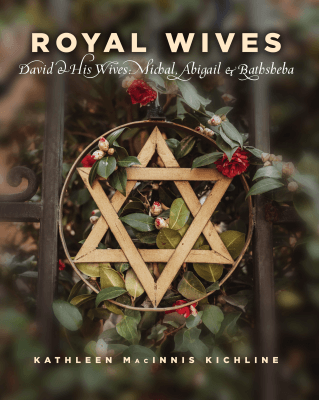
Our newest offering ROYAL WIVES, a mini-study of six sessions, perfect for on-the-go small groups. Men and women both appreciate the back and forth of his and her stories.
Larger-than-life, David. Much of the Hebrew Scriptures are given over to him as he rises from shepherd boy to the greatest hero and king of Israel. Over the course of his lifetime, David takes on many roles: slayer of a giant, poet, soldier, friend, refugee, leader, singer, king, father, diplomat, even dancer. In ROYAL WIVES we look only at a narrow portion of his life, that of husband, an aspect rarely focused upon but one with intriguing possibilities. There are many women in David’s life, but we are only given the names and stories of three of his wives: Michal, Abigail, and Bathsheba, but each gives a glimpse of the young David, the midlife David and the mature David.
To preview or order on Amazon, click below:
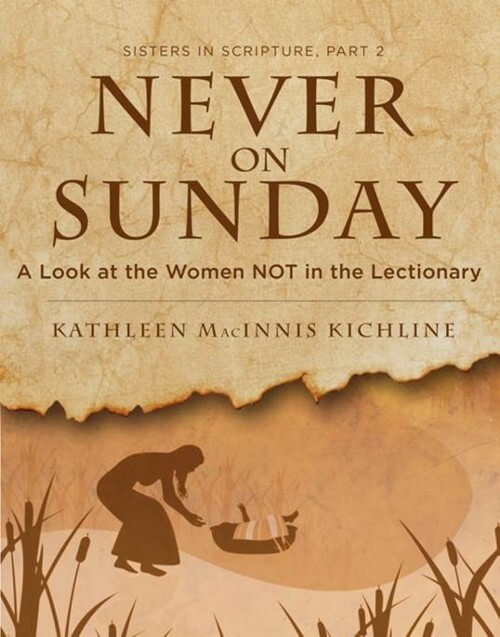
NEVER ON SUNDAY tells the stories of women whose name do NOT appear in the selected Sunday readings. Collectively, they represent a significant portion of biblical women. Their life stores, circumstances, and witness of faith will never be read aloud on a Sunday or developed in the homily. By retrieving these pieces we reclaim an important part of our heritage as daughters and sons of the living God and followers of Jesus Christ. The names and stories of these women, Jochebed through Junia, deserve to be heard and told.
To preview or order on Amazon, click below:
ALSO AVAILABLE IN SPANISH in two parts as NUNCA EN DOMINGO. To preview or order on Amazon, click here: Old Testament NUNCA EN DOMINGO / New Testament NUNCA EN DOMINGO
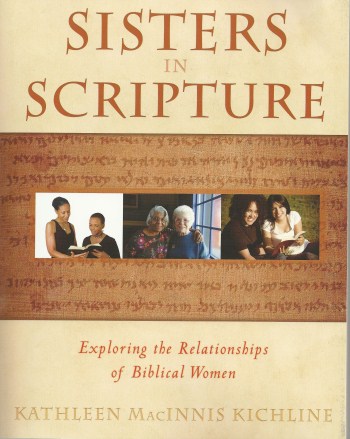
And the book that started it all, SISTERS IN SCRIPTURE: A Look at the Relationships of Biblical Women.
SISTERS IN SCRIPTURE is a great bible study that teaches the tools of biblical scholarship and offers engaging reflection questions that prompt small group faith sharing. Participants are intrigued to discover how close are the stories of these biblical women to their own.
To preview or order on Amazon, click below:
Poetry...
God prays
Yes, child, I hear you.
I know your suffering.
I know because I am in you, suffering.
And no, it is not fair.
But then, nothing is fair.
I did not create “fair.”
I did not create “deserving.”
You all did.
I created only being—
and, because it is mine, it is being Beloved.
You wonder if I'm here,
listening, responding.
Remember when you fell,
and your mommy held you?
Remember her love,
and how it comforted you
and made it better?
I don't manage the world.
I don't push things around,
not bullets or germs or people.
But I love you.
I won't save you from life's hurts,
even the awful ones.
But I am here, holding you.
With all my heart I want your wholeness,
and even now in ways you can't see
healing is happening in your body and soul,
and in the world.
That is me. That is my love.
My dear one, I hear you.
I pray to you, to trust me.
I am holding you.
Steve Garnaas-Holmes
Unfolding Light
Responses from Readers...
Contact Kathleen
I love to hear from you, friends! Please drop me a line at Contact Kathleen
If you are new to Sisters in Scripture, I would love for us to stay in touch. To receive regular emails, sign up here.