

And having been warned by God in a dream not to return to Herod, the magi left for their own country by another way.(Mt 2:12)
With these lines from the Epiphany reading, the church leaves the scene of the Christmas story. But as with ourselves, once the guests have left and the packages put away, life goes on. And it often does so with violent abruptness. Headlines startle, bad news unnerves, suffering saddens. Even just that first day back to commute, work, and school can slam us. Life goes on.
And the story goes on. Matthew continues telling a riveting tale that is also violent, unnerving, and sad. Apparently, this decision of God's to become fully human immediately turns terribly real. The newborn babe and his parents get caught up in the the larger world. Read on.
Now when they had gone, behold, an angel of the Lord *appeared to Joseph in a dream and said, “Get up! Take the Child and His mother and flee to Egypt, and remain there until I tell you; for Herod is going to search for the Child to destroy Him.” So Joseph got up and took the Child and His mother while it was still night, and left for Egypt. He remained there until the death of Herod. This was to fulfill what had been spoken by the Lord through the prophet: “Out of Egypt I called My Son.”(Mt. 2:13-15)
If we stay only with the familiar, beloved Lukan narrative of Christmas, the story may be put away with the decorations and nativity set. But...
"what if the story were told instead of a father awakened by a nightmare to sit bolt upright in bed, cold with fear. Only it was no nightmare; it was warning, and it was real. He knew because the angel had warned him before and could be trusted. Evil, dangerous men were coming in search of his wife and his child, intent on murdering them in their beds. He only had time to awaken them, gather a few things, and flee into the night. Guided by stars and perhaps more dreams, he leaned into the desert winds, looking over his shoulder, and shielding his family.
They left all that they knew, uncertain of when or if they would return, and they descended into the foreign land of an ancient enemy, there to seek refuge and hide among those they did not know. And amid all that chaos, the story reaches its climax…that in the middle of all the chaos, God was with them.
"Maybe if you have had cold sweats, have feared for your life or your child’s, have owned nothing more than what you could pack on your back, maybe if you have heard your neighbors’ screams in the night, have left behind family and friends, are alone, hungry and tired and aching, maybe you would hear this story and think, “Yes, that man is me. That story is like mine.” And when you heard it's moral, “God was with them,” you would be startled and look around to see if God could also be with you.
"That might become your Christmas story, at least for this year. Once upon a time, you would say, when my life was in peril and at its worse, God was with me. That is what Emmanuel means, God-with-us. And that Christmas story would become your own."
(WTW, pp. 139-140)

Then when Herod saw that he had been tricked by the magi, he became very enraged, and sent and slew all the male children who were in Bethlehem and all its vicinity, from two years old and under, according to the time which he had determined from the magi. Then what had been spoken through Jeremiah the prophet was fulfilled: “A voice was heard in Ramah, wailing and loud lamentation, Rachel weeping for her children; she refused to be consoled, because they are no more.
(Mt. 2: 16-19)
This violent story is a designated weekday reading 3 days after Christmas on Dec 28th. It is never proclaimed on a Sunday in any of the three liturgical cycles. Perhaps for good reason. Pity the preacher left to provide insight or meaning to such a horrific tragedy. Pity the parents who need to explain it to a child now old enough to understand what she hears.
And yet there it is. It happened. What are we to make of this? What are we to make of any headlines that shred our hearts? And within days of Christmas? Questions abound. When and how did Joseph and Mary hear what had happened to the babies of their neighbors. How didthey internalize the news?
One of the questions asked by early Christians was, what of John, the infant cousin of Jesus whose home lay "in the vicinity?" The above picture show a fresco from the Church of the Visitation in Ein Karem where the home of Elizabeth, Zechariah, and John is believed to have been. In the midst of the chaos of innocents being murdered by Herod's henchmen, Elizabeth and John find refuge in the cleft of a rock miraculously opened by the angel standing guard. (based on Proto Evangelion James 22:3)
Perhaps contemporary ponderings on this troubling event will focus, instead, on how little has changed in these 2000 years. Innocent life is still at risk from the vengeance of despots. Yet Christ's arrival into the world calls us to view this from the stance of hope. Despite what can seem like evidence to the contrary, Christ's coming changes all things. I find that pastor-poet, Steven Garnaas-Holmes, captures it well--as poetry so often does:
New Feature!!
The above Scribble is now available in AUDIO VERSION. You may access it by clicking here: Listen to Scribbles Past issues of SCRIBBLES are also being updated with audio versions for access any time. Enjoy! (and tell others)
Poetry...
Epiphany
by Steven Garnaas-Holmes, Unfolding Light
When we look at the way artists have portrayed this scene, we will see that the "others" can be many.
Herod is still king, no doubt about that.
The lovely story of the visit of the magi
will be followed by slaughter in Bethlehem.
The little baby will have to grow up
and go out into the world that will crucify him,
overseen by another Herod.
Look around: Herod returns again and again.
But the end of the story isn’t there,
in political power and violence.
The end is here, at the beginning:
under the nose of the king of dominance
the kings of wisdom kneel and pay homage
to the king of love.
Herods and their mobs will come and go,
but love remains, and remains in power.
Like we think we’ve conquered nature,
but she rules with her eternal laws—
so love reigns, despite what despots think.
Love frightens those who want to dominate:
it undermines power structures and erodes hierarchies.
It is the energy of the universe,
and magi see it even in the stars.
Herod is still there, still frightened.
Kneel to a greater king.
One more offering, "The Journey of the Magi," by T.S. Eliot. Like Tissot and Tanner, Eliot experienced religious awakening. At age 39, he was baptized into the Anglican Church. Critics see in this poem traces of his own spiritual journey, the hardships and obstacles overcome, an event that left him forever changed, no longer at ease with the world he once knew, still full of questions and yearning, "hints followed by guesses,"(line from his poem, "Four Quartets"). Too long to include here, I've included a YouTube reading of it by Alec Guinness. Enjoy! "The Journey of the Magi, T. S. Eliot (listening time: 3.5 minutes)
Art...
"Les rois mages en voyage" (c. 1894) by James Tissot is a powerful depiction of three imposing figures descending from the distant hills in a way that fills the scene and compels attention. The artist, Tissot, visited Palestine three times, 1886-1896 to sketch and photograph people, clothing, topography, and light. He places the Magi in the shadow of the volcanic hills that surround the Dead Sea, a vast and arid landscape between Jericho, Kedron, and Jerusalem.
Originally a painter of the stylish, leisure class of the late 19th century, a genre for which he is still well-known, Tissot had a religious experience late in life that prompted his travels to the Holy Land and directed him toward depicted biblical scenes.
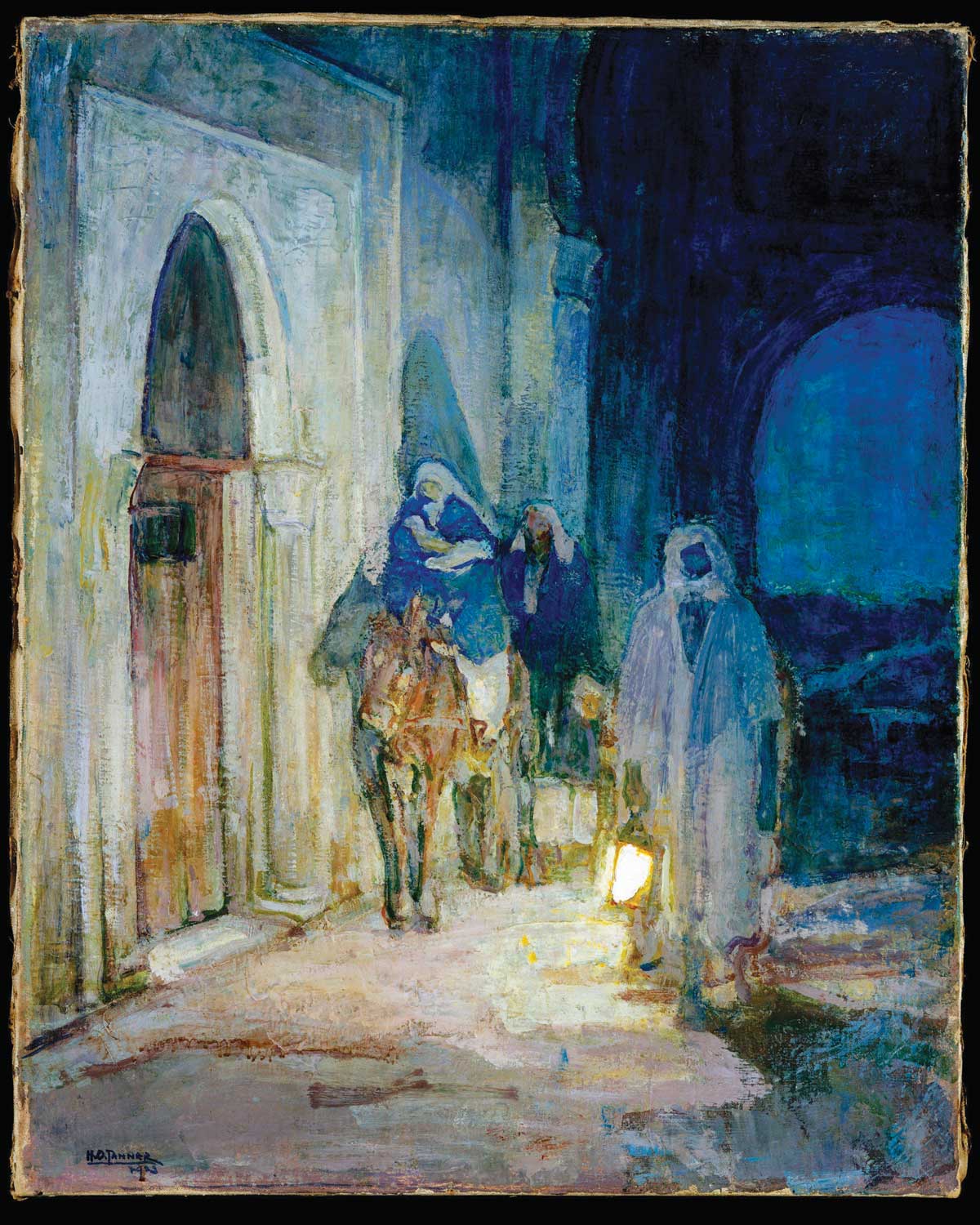
The "Flight to Egypt," (1923) is the last of four on this topic painted by Henry Ossawa Tanner. A sense of isolation and imminent danger pervades the scene even as the circle of light emanates from an other-worldly presence, a pillar of angelic protection and guidance. This interpretation resonates with Tanner's own sensitivity to issues of personal freedom and mobility. He was the first-born son of an AME preacher, later bishop, and a woman who'd been born into slavery and escaped to the North via the Underground Railroad. He left the US for France saying, "I cannot paint and fight prejudice at the same time." He'd inherited a deep religious sensibility, but, like Tissot, had a later in life religious experience about which he wrote to his parents, an experience that redirected much of his art toward the religious.
As mentioned, the third scene is a fresco from the Church of the Visitation in Ein Karem, now in the outskirts of Jerusalem. My friend, Libby Goldstein, first told me about the beauty of the artwork, but also that because women from the Old Testament are honored in these frescoes, women from all three religions: Christianity, Judaism, and Islam frequently visit, for these are our shared faith ancestors. Here is a video clip if you would like to visit Ein Karem (viewing time: 9:30 min, minus addition at end)
Responses from Readers...
(in response to Dec 11th Scribbles, "She Said Yes"
But we are told of meek obedience. No one mentions
courage.
The engendering Spirit
did not enter her without consent.
God waited.
She was free
to accept or to refuse, choice
integral to humanness.
Hugs, love and Christmas blessings,. - Alice

Contact Kathleen
As always, I love to hear from you; contact me at Contact Kathleen
If you are new to Sisters in Scripture, I would love for us to stay in touch. To receive regular emails, sign up here.