Please ensure Javascript is enabled for purposes of website accessibility

An Advent Gift Week Three

Scribbles from...

"For, the purpose of Advent is not that we await the coming of Christ; it is that Christ waits upon our awaiting. On some level, Christ does not, cannot come without the beckoning of our need and deep desire. Lest our hearts become the manger, where shall He be received?"(WTW, p. 10).

Let us prepare our hearts to be the manger. Let us warm up and stretch our souls. Let us allow ourselves to be pulled into Advent through sense, imagination, and intention.
MARY AND THE WOMEN OF MATTHEW ONE

Scripture

MARY AND 
THE WOMEN OF MATTHEW ONE

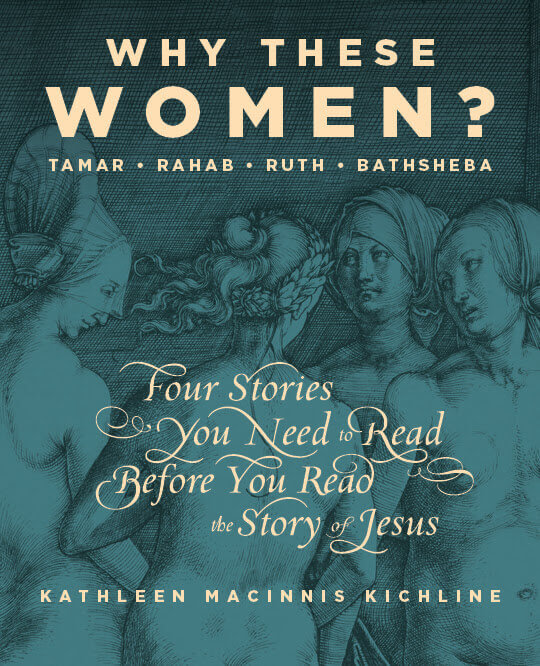
Tamar, Rahab, Ruth, and Bathsheba. They seem at first, odd company for her to keep.  Yet, she belongs with them; each of their lives, in some way, points to hers. As a Jew, she would have learned these stories, studied them, heard them read and discussed at synagogue. How did the stories of these women speak to her? What did she notice as she pondered their lives? Perhaps, she saw the connection in their stories and hers long before any of us did.

ADVENT WEEK THREE - RUTH

No doubt, as Mary pondered the story of Ruth and Naomi, she, too, noticed the many parallels with her own life:

  • The setting of Bethlehem
  • Righteous husbands, Boaz and Joseph
  • Elder women companions and mentors, Naomi and Elizabeth
  • Ruth’s “I will go...,” Mary’s “Be it done to me…”
  • Identifying with the lowly
  • Living with hesed

When Joseph awoke from sleep, he did as the angel of the Lord commanded him; he took her as his wife” (Mt. 1:24). Thus began the married life of Mary and Joseph. Like an old-fashioned movie that pans away from lovers at the threshold, the scriptures lead us just this far. Matthew does hasten to assure us that Joseph “had no marital relations with her until she had borne a son” (vs. 25), an important detail for his readers who do not yet know the fullness of Jesus’ identity. 

We, however, have no such concerns in this moment. This young couple, like Ruth and Boaz, come together and become part of a larger story. Perhaps on the day that Joseph took Mary into his home, he did exactly as his forefather had done and extended his cloak over his new bride. Thus, would he honor her, welcome her, and pledge himself to her. And Mary would have understood. We can further imagine a Mary who, though she was young, was also without guile, free to speak to her husband what stirred in her heart. She could receive his noble gesture whole-heartedly, recognizing thehesed that Joseph offered her. In such a home, the boy Jesus would have grown andincreased in wisdom and in years and in divine and human favor (Lk. 2:52). And he would have learned the stories of his ancestors, learned them in a way that unlocked hearts.  (WHY THESE WOMEN, pp. 133-4)

As we consider the similarities between Ruth and Mary, let us hone in on the two elder women in their lives: Naomi, the mother-in-law of Ruth, and Elizabeth, the cousin of Mary. This allows us to reflect upon a passage from Luke's Nativity narrative in our Advent preparation, the Visitation:

Now at this time Mary arose and went in a hurry to the hill country, to a city of Judah, and entered the house of Zacharias and greeted Elizabeth. When Elizabeth heard Mary’s greeting, the baby leaped in her womb; and Elizabeth was filled with the Holy Spirit. And she cried out with a loud voice and said, “Blessed are you among women, and blessed is the fruit of your womb!  And how has it happened to me, that the mother of my Lord would come to me? For behold, when the sound of your greeting reached my ears, the baby leaped in my womb for joy. And blessed is she who believed that there would be a fulfillment of what had been spoken to her by the Lord.” (Luke 1:39-45).

This sacred encounter captures what is at the heart of Sisters in Scripture, women working together to bring about God's saving action in the world. In that moment of recognition, Elizabeth and Mary rejoiced not only in their reunion with one another but also in the realization that God was with and within them.

I find it fascinating both women immediately give voice to prayer. Elizabeth's greeting becomes the Hail Mary, that oft-repeated prayer that is the mantra of the rosary. Mary's response, the Magnificat, is a triumphant shout into the future, the song that, in many traditions, is folded into Evening Prayer at the close of every day. Prayer, it seems, is always at the heart of the relationships among women of faith.

Art - Two Offerings

Macha Chmakoff is a well-known contemporary artist and psychoanalyst who frequently paints on religious subjects, this being just one of her many representations of The Visitation. She applies self-ground pigments to the canvas by knife depicting a reality that is not directly visible, preferring instead to work at the edge of the figurative. She tries to present what is behind the facade, allowing the viewer to participate in the interpretation. In the evocative nature of this painting, we are invited into the scene, invited to consider our own holy encounters.
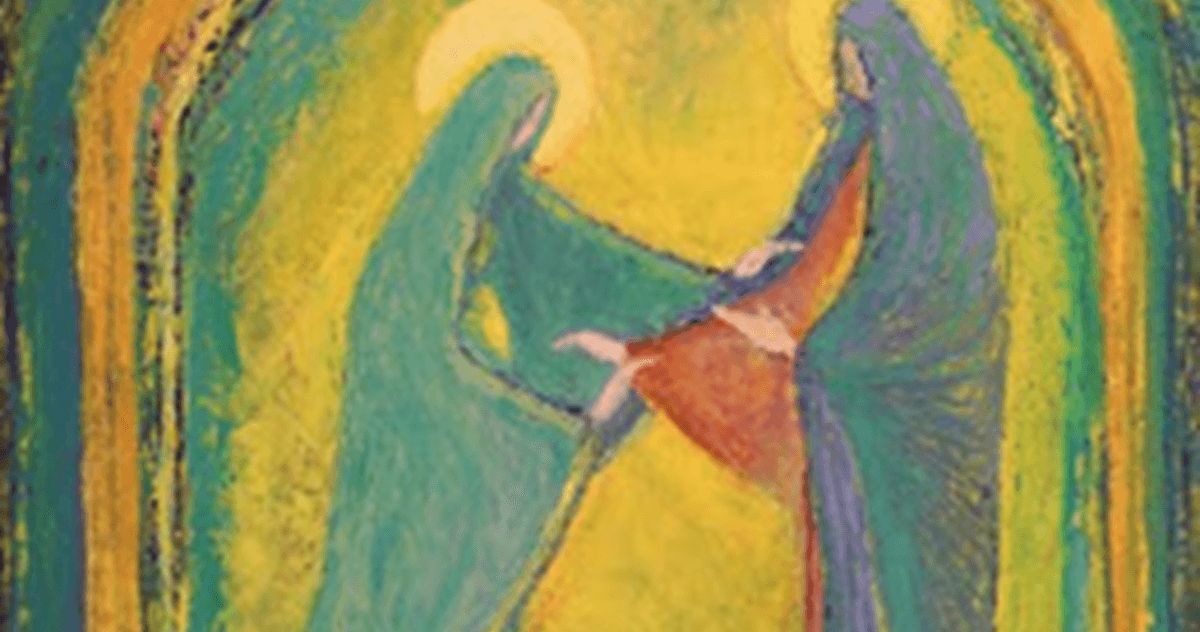
In this rendering of the Visitation, the meeting of Mary and Elizabeth, artist Bradi Barth has chosen to make transparent the reaction of John the Baptist to Jesus, his cousin and Lord. The two infants, in utero, rejoice in one another even as their mothers joyfully greet. I find Barth's style appealing and appropriate for her subject matter. She chooses an accurate Palestinian background, but then frames the foursome within open walls. A devotee of the Dutch Masters, she borrows from iconography in this depiction of the two babes. Bradi Barth was born in Switzerland in 1922 and continued her career, mostly in religious subjects until her death in Ghent, Belgium in 2007.

Poetry

Elizabeth's prophetic greeting prompts a similar response in Mary as she proclaims these words of prophetic liberation:

And Mary said:
“My soul exalts the Lord,
And my spirit has rejoiced in God my Savior.
For He has had regard for the humble state of His bondslave;
For behold, from this time on all generations will count me blessed.
For the Mighty One has done great things for me;
And holy is His name.
And His mercy is upon generation after generation
Toward those who fear Him.
He has done mighty deeds with His arm;
He has scattered those who were proud in the thoughts of their heart.
He has brought down rulers from their thrones,
And has exalted those who were humble.
He has filled the hungry with good things;
And sent away the rich empty-handed.
He has given help to Israel His servant,
In remembrance of His mercy,
As He spoke to our fathers,
To Abraham and his descendants forever.” (Luke 1:46-55)

These words that Luke attributes to Mary are variously known as Mary’s Canticle, the Magnificat[1], or her Song of Praise. Here Mary stands in a long tradition of other women in the Hebrew scriptures who also offer canticles: Miriam, Deborah, Hannah, and Judith.[2] Her canticle is one of three that are offered in these first two chapters of Luke.[3]   All point to God’s saving action in the coming Christ, but Mary’s Canticle uses particularly powerful images of the reversal of power:

  • He has shown strength with his arm
  • He has scattered the proud
  • He has brought down the powerful from their thrones,
  • and lifted up the lowly
  • he has filled the hungry with good things,
  • and sent the rich away empty

So strong are these images, in fact, that we, the rich of the first world, are often uncomfortable in their reading. We are fine with the hungry being fed, but not at the cost of the rich being sent away empty. This is true reversal. What Mary proclaims, the coming Kingdom, does not arrive without cost. Likehesed, the loving-kindness that requires action, not sentiment, the Kingdom will not come on good will alone.(WTW, p. 128).

[1] Magnificat draws its name from the opening word in the Latin translation, Magnificat,for “My soul magnifies…”

[2] Miriam (Exodus 15:20-21), Deborah (Judges 5:1-5,31), Hannah (1 Sam. 2:1-10), Judith (Judith 16:2-21). 

[3] Zechariah also sings a song of praise at the birth of his son, John the Baptist (1:68-79), and Simeon does so at the temple when he recognizes the Messiah in the infant Jesus (2:29-32).

This Mary of the Magnificat, this Mary that I have seen Betsey dance many times, this Mary of stirring and powerful words is captured well in the following poem:

Mary

Mary. She's no innocent, naif, angel sunned, subservient:
she's young, yes, and humble, and not knowing the outcome--
but she knows what she's doing.
She's heard Gabriel, heard God in her flesh,
dared to trust the incendiary power of ordinary love,
and to believe the Divine in her,
seized her power to choose,
to be an agent of God's re-ordering of the world--
and said Yes. Yes to all of that.

Yes not just to having a baby,
not just to bearing grace and birthing love,
but to raising a son, nursing his imagination,
teaching him, showing him, preparing him
for what she knows he can do.
She takes it on.
And so takes on the Empire,
the topping of thrones, the lifting of the lowly,
the great reversal of evil itself.

Mighty woman. Dangerous Lover.
Divine womb. Mother of God.
Adore her, not on sweet cards but protest posters.
Not with pallid piety, but in the streets,
in the raising of children baptize with Spirit and fire,
in the heavenly upheaval in your own flesh and soul,
in the Divine presence in your plain, powerful life--
adore her. Learn at her feet.
Be her child.

Steve Garnaas-Holmes website is worth a visit:Unfolding Light

Music

Mary's Magnificat has been put to many a musical score, in part because it is part of Evening Prayer in many traditions. It has even been danced if you are one of the lucky ones, like me, who have seen Betsey Beckman's StoryDance. This version focuses on the relevancy of those prophetic lines wherein God will raise up the lowly.

Advent Song

Where last week's instrumental created a blank slate for your inspiration, today's music juxtaposes images that match the challenging nature of Mary's words. The variety presented speaks to the way in which Mary has been appropriated by many cultures. In the gaze between the two women and their in utero sons, there exists a namaste kind of reverence. And I think of the Posada celebration when I see the image that matches, "You fill the empty with good things..." Pay attention to the effect the images and words have on you.(Please be patient if commercials volunteer themselves before viewing).

To ponder...


  • Who has been an "Elizabeth" to you, a mentor, supporter, someone who knows better than you know yourself? Do you have other women in your life who share and support you in your faith journey? To whom have you been an "Elizabeth," someone who looks to you for guidance, support, or advice? How can you convey your appreciation if you have women such as these in your life? How can you foster such relationships if you do not already have them?
  • Mary's Magnificat is a manifesto that reminds us that Christmas is more than looking back or, even, looking within; Christmas is future oriented, other-centered. How will you incorporate creating a better world into your Advent / Christmas plans for this year? What would a better world look like to you? Be specific in ways you can contribute to that.
  • Find a word that expresses the effect the song had upon you. Whisper that word as you light your Advent candle.
  • "Prayer, it seems, is always at the heart of the relationships among women of faith." Thus, we come to know one another in the gathering to pray, join our prayers in common concern for God's justice and peace in this world. We call upon one another for support in prayer and we share our joy in prayer, as did the woman with the lost coin, "come rejoice with me for I have found what was lost." (Lk 15:9) Consider those times and persons who occasion such encounters. Be grateful and be intentional in those relationships. (Insert is picture of "prayer curls," names or intentions on slips of paper)

The Exciting News...

and another woman of faith I've partnered with

It was my great pleasure some months ago to be interviewed on my book, WHY THESE WOMEN for an Advent podcast to be aired this coming week. The interview can be heard Monday, December 18th on GOD HEARS HER hosted by Elisa Morgan and Eryn Adkins. God Hears Her is a collection of resources that "encourages women to know that God is with her, God is for her, and God hears her and her hearts cry. Over and over in the Bible, God heard and responded to the needs of women like Hannah, Rachel, and Mary Magdalene. He is still listening and responding today."

Some years back, I was the prayer leader when Elisa spoke to an ecumenical gathering of women at Advent Lutheran in Mill Creek, WA. We connected then and have stayed connected ever since. And is it not true that God has a way of bringing things round? It was a joy to share my book with Elisa and Eryn and it is my further joy to share that conversation with you.(NOTE: This interview will not be "live" until Mon. Dec 18th. I will continue to provide the link in future Scribbles) CLICK BELOW:

Advent News

Comments from Readers on last week's Scribbles...

  • Thank you for the beautiful musical reflection of O Come O Come Emmanuel. You...truly bring the Scripture to life in unique and wonderful ways. The art, music, poetry, and words you choose deepen my own reflections. Thank you. - Jeannette, S.P.
  • Kathleen, I love the piano/cello version of O Come, O Come Emmanuel as you’re right, it moves us to prayer. So much so that as I listened, I decided I’d take it to the prison where I’m a chaplain and play it for the men to soothe their souls during this time when it must be more difficult than ever for them to be away from their families and loved ones. Thank you so much! - Gloria
  • Your Scribbles have inspired me to begin to "scribble" and write intentionally as we did at your retreats...a notebook of drawings, short reflections, poems and many, many questions. I am not a young virgin nor a prostitute, but I hope I can find my YES this Advent, freely given knowing that every yes will affect my community and maybe generations to come. Thank you for the continual inspiration. - Cari
  • And an especially dear comment from a long ago past that I found while preparing this. It was written in a familiar hand on a scrap of paper used as a bookmark:

I browsed through your book,
just a little look.
I felt your presence in the pages,
thought of Christmas through the ages.
The one I liked the best of all
is by your favorite, Luci Shaw. - Mom

The Visitation prompts me to recall all those women with whom I have partnered through the years, women whose purpose is to be Christ-bearers, hope-bringers, and compassionate companions. It continues to give me joy to create these "Scribbles" so that I can extend that same invitation to you.

Thank you for sharing your thoughts on Advent with me and the rest of us. I look forward to hearing more! Please drop me a line at Kathleen.

If you are new to Sisters in Scripture, I would love for us to stay in touch. To receive regular emails, sign up here